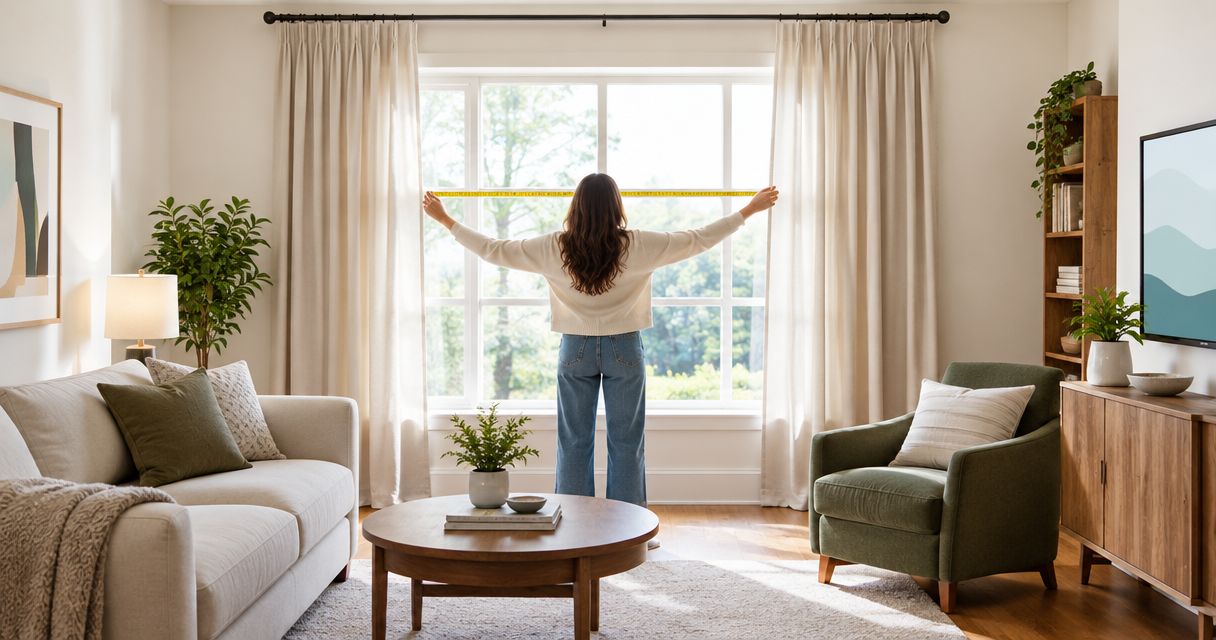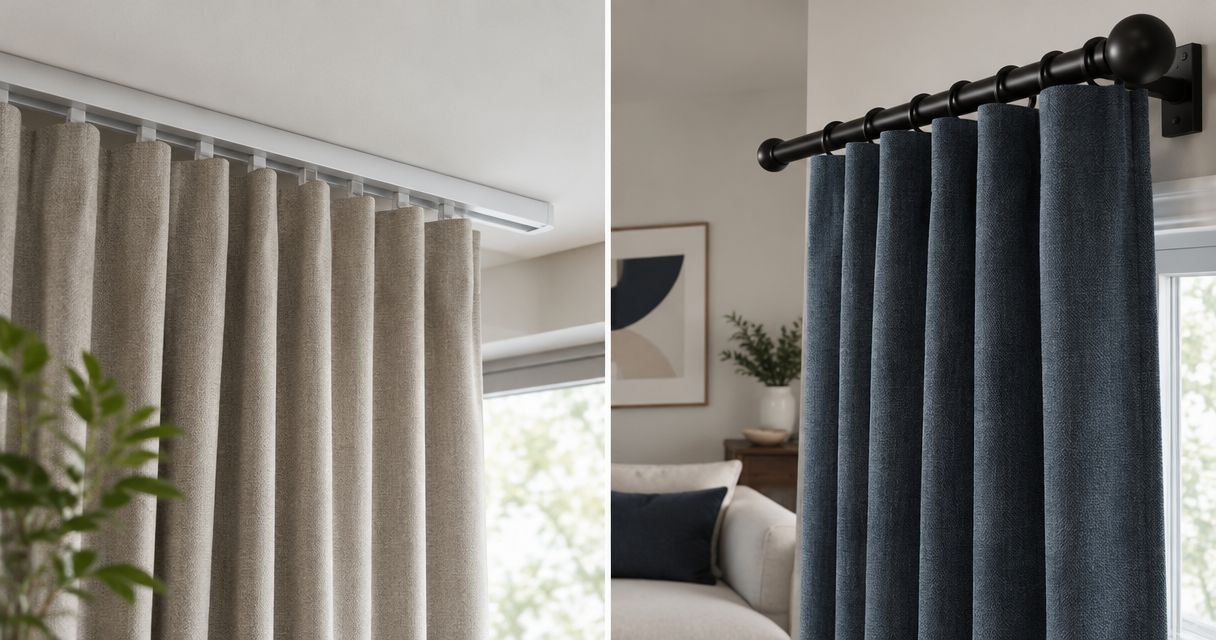
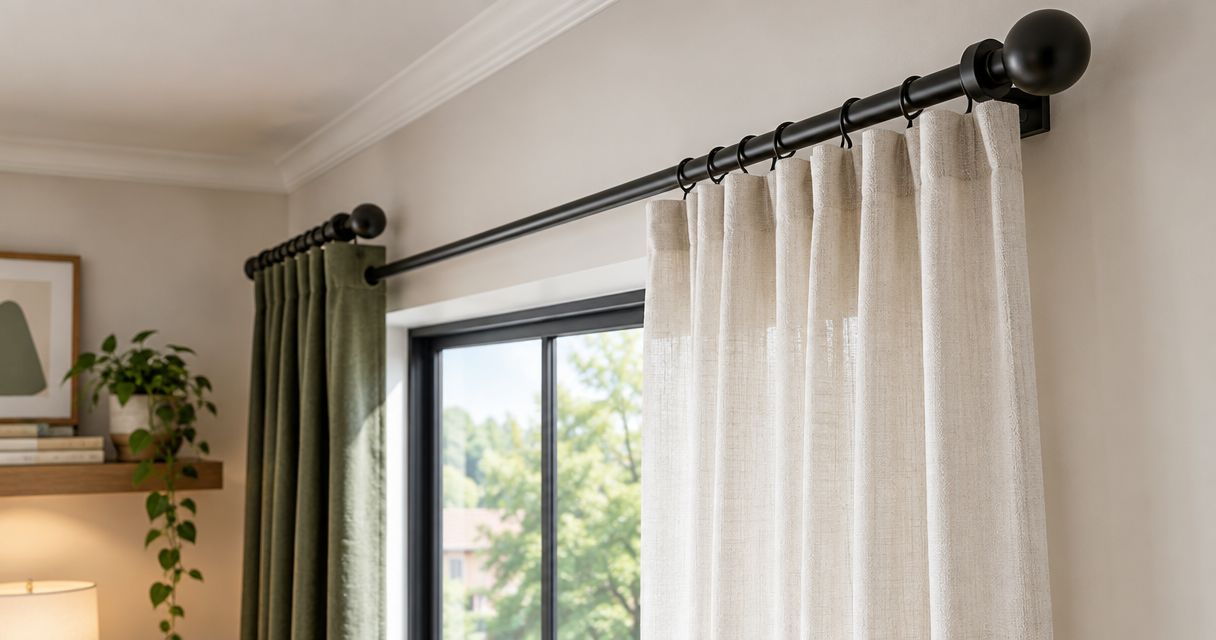
Picking between a motorized track, a wooden pole, and a plain wall rod comes down to three things: how heavy your curtain fabric is, whether you want manual or remote control, and whether you want the hardware hidden or on show. The best curtain rods and tracks in 2026 for Riyadh homes split cleanly by use case rather than one winner for everyone: motorized tracks for smart-home control, ceiling-mounted tracks for hidden hardware behind floor-to-ceiling curtains, wall-mounted metal rods for statement looks, wooden poles for villa interiors, double-track systems for layering sheer with blackout, and telescopic rods for apartments and rentals.
- Ceiling-mounted tracks win for most Riyadh living rooms because they hide hardware under heavy blackout fabric.
- Motorized curtain tracks are the pick for smart homes that want app or remote control in 2026.
- Wooden curtain poles suit villas and warm interiors paired with linen curtains.
- Double-track systems let you hang sheer and blackout curtains together on one window.
- Telescopic wall rods fit apartments and rentals since they need no ceiling drilling.
Why this matters
Riyadh sun is intense for most of the year, and heavier fabrics like blackout and velvet put more strain on hardware than a light sheer panel does. A rod rated for cotton curtains will sag under a lined blackout panel within months, and a cheap ceiling bracket can pull loose from plasterboard. Curtain Store fits curtains and rods together for exactly this reason: the hardware has to match the fabric, the window, and how often the curtain gets opened and closed.
This matters more in villas and apartments than most homeowners expect. A grommet-top curtain in heavy fabric behaves differently on a track than on a rod, and getting that wrong shows up as uneven folds or a track that jams within a year.
What makes the best curtain rods and tracks
Before ranking anything, here is what actually separates a good curtain track from a bad one:
- Weight capacity — matched to the fabric, not just the window width
- Mounting type — wall-mounted versus ceiling-mounted changes how the curtain drops and how much hardware shows
- Manual or motorized operation — remote and app control versus a hand-pulled cord or direct pull
- Material and finish — steel and aluminum resist warping better than untreated wood in a dry, dusty climate
- Compatibility with the curtain heading — grommet, pleat, and tab-top styles each need a different rod diameter or track glider
- Ease of professional installation — ceiling tracks and motorized systems need accurate measurement more than a basic wall rod does
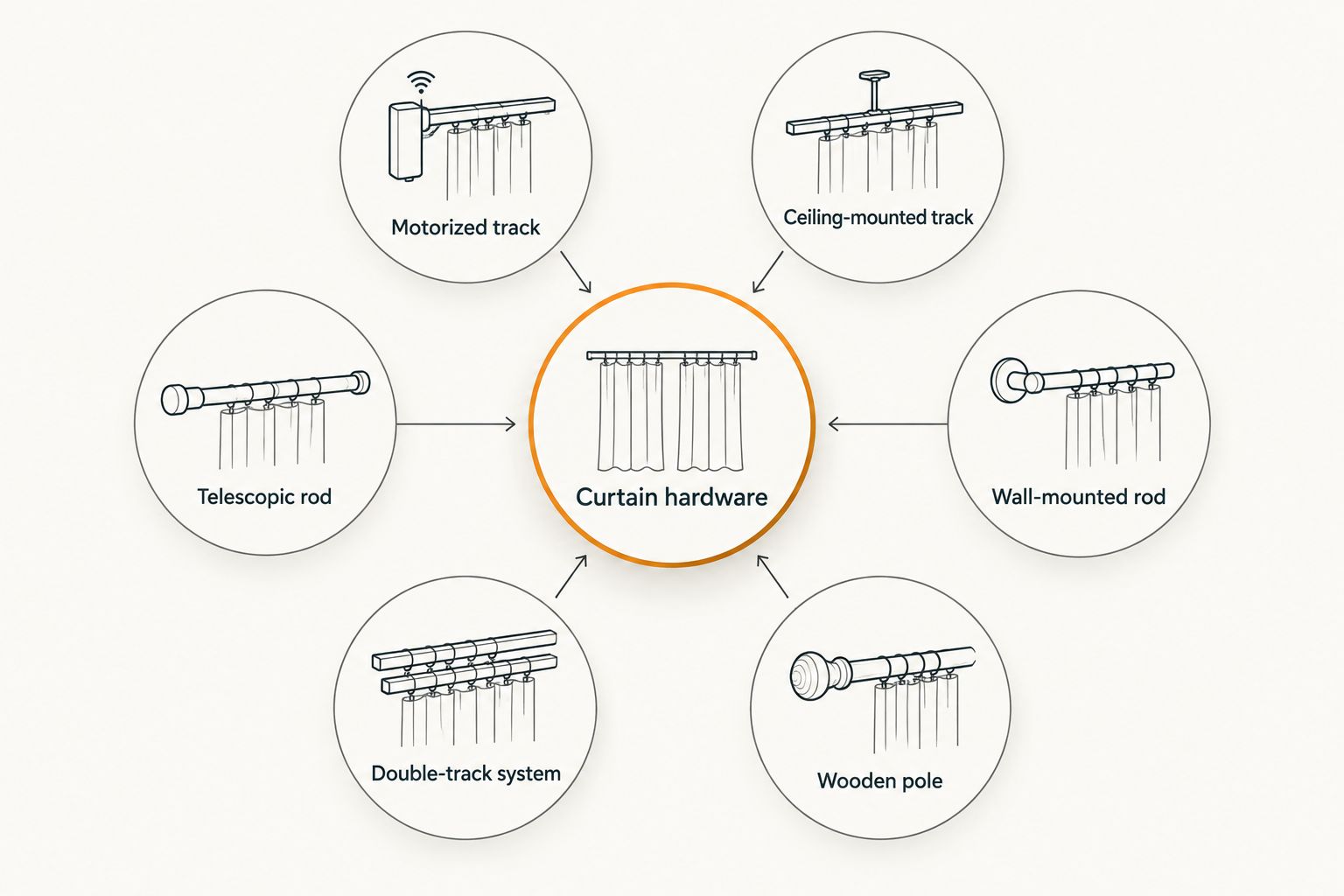
Curtain rods and tracks at a glance
| Type | Best for | Standout feature | Key limitation |
|---|---|---|---|
| Motorized curtain track | Smart homes | Remote or app control | Needs power access near the window |
| Ceiling-mounted track | Floor-to-ceiling curtains | Hardware disappears into the ceiling line | Ceiling must be solid enough for anchors |
| Wall-mounted metal rod | Statement decorative curtains | Visible finial and pole add a finished look | Adds visual weight to smaller windows |
| Wooden curtain pole | Villas and warm interiors | Natural finish suits linen and heavier drapes | Can warp faster than metal in humid rooms |
| Double-track system | Layered sheer and blackout | Runs two curtain layers on one window | Wider bracket needed, more measuring |
| Telescopic wall rod | Apartments and rentals | Adjusts to fit without drilling extra holes | Lower weight capacity than a fixed track |
1. Motorized curtain tracks: best for smart homes
A motorized track runs the curtain glider along a rail using a small motor, controlled by a remote, wall switch, or a phone app. It replaces the manual pull cord entirely, so the curtain opens and closes without anyone touching the fabric.
Motorized curtain track pros:
- Opens and closes curtains without physical contact
- Works well with tall or hard-to-reach windows
- Pairs naturally with other smart-home routines
Motorized curtain track cons:
- Needs a power source near the track
- More components mean more that can eventually need servicing
- Overkill for a small bedroom window
Best for: homeowners building a smart home in 2026 who want curtains on the same system as their lighting. Verdict: Choose it if remote control matters more than keeping things simple.
2. Ceiling-mounted curtain tracks: best for floor-to-ceiling curtains
A ceiling-mounted track fixes directly to the ceiling rather than the wall above the window, letting the curtain hang from the ceiling line down to the floor with no visible rod or bracket. It is the standard choice behind heavy blackout and living-room curtains where a clean look matters.
Ceiling-mounted track pros:
- Hardware is invisible once the curtain is hung
- Suits floor-to-ceiling drops in majlis and living rooms
- Handles heavier lined fabrics well when installed correctly
Ceiling-mounted track cons:
- Needs solid ceiling material for secure anchoring
- Harder to reposition later than a wall rod
Best for: living rooms and majlis spaces where the curtain, not the hardware, should be the focal point. Verdict: Choose it for most standard Riyadh living rooms.

Mounting height matters here: for a true floor-to-ceiling look, the track sits close to the ceiling line, and installers typically leave the rod extending about 10-15 cm beyond the window frame on each side so the curtain clears the glass fully when open.
3. Wall-mounted metal curtain rods: best for statement curtains
A wall-mounted rod fixes to the wall above the window frame using visible brackets, with the pole itself often finished in matte black, bronze, or brushed steel. Finials on each end give it a decorative role beyond just holding the fabric.
Wall-mounted metal rod pros:
- Adds a finished, decorative element to the window
- Simple to install compared to ceiling tracks
- Works with a wide range of curtain headings
Wall-mounted metal rod cons:
- Hardware stays visible, which some rooms don't want
- Not ideal for very heavy blackout fabric on long spans
Best for: bedrooms and home offices where the rod itself is part of the decor. Verdict: Choose it when you want the hardware seen, not hidden.
4. Wooden curtain poles: best for villas and warm interiors
A wooden pole brings a warmer, more traditional look than metal, and pairs naturally with linen and heavier natural-fiber curtains common in villa interiors. It mounts on wall brackets similar to a metal rod but with a thicker, more tactile finish.
Wooden curtain pole pros:
- Warm, natural finish suits villa and traditional interiors
- Sturdy enough for heavier linen curtains
- Available in tones that match existing wood furniture
Wooden curtain pole cons:
- Can warp over time in rooms with humidity swings
- Heavier poles need stronger wall anchors
Best for: villa living rooms and bedrooms furnished with linen curtains and natural wood pieces. Verdict: Choose it for a warmer look; skip it in bathrooms or kitchens near steam.
Get help choosing the right track
Talk through measurement and installation options for your windows.
5. Double-track systems: best for layering sheer and blackout
A double-track system runs two parallel tracks on one bracket, so a sheer curtain hangs on the inner track and a blackout or heavier curtain hangs on the outer one. You pull the sheer during the day for light and privacy, then close the blackout layer at night.
Double-track system pros:
- Lets one window run two curtain layers
- Sheer layer filters daylight while blackout handles glare and heat
- Practical for bedrooms that need both privacy and darkness
Double-track system cons:
- Needs a wider bracket and more precise measuring
- Two layers cost more to fit than a single track
Best for: bedrooms and living rooms that want sheer during the day and full blackout at night. Leave roughly 5 cm of clearance between the two tracks so the layers don't catch on each other. Verdict: Choose it if you already own or plan to buy both a sheer and a blackout curtain.
6. Telescopic wall rods: best for apartments and rentals
A telescopic rod extends and retracts to fit a window without cutting to size, and mounts with brackets that need only a couple of screw points. It's the lightest and quickest hardware to fit on this list.
Telescopic rod pros:
- Adjusts to fit without custom cutting
- Minimal drilling, easy to remove when moving out
- Affordable way to hang ready-made curtains
Telescopic rod cons:
- Lower weight capacity than a fixed metal or ceiling track
- Can sag slightly under heavy lined fabric over time
Best for: apartment renters and short-term setups that need curtains up fast without ceiling work. Verdict: Choose it for light to mid-weight ready-made curtains; wait if you're planning heavy blackout panels long-term.
How this list was ranked
Each type was placed against the six criteria above: weight capacity, mounting type, manual versus motorized control, material durability, heading compatibility, and installation difficulty. No two items compete for the same use case — a villa owner choosing between a wooden pole and a ceiling track is choosing a look, not comparing a better and worse version of the same thing.
Which curtain rods and tracks should you choose?
If you're not sure where to start, default to a ceiling-mounted track for any living room or majlis with floor-to-ceiling curtains — it covers the widest range of fabric weights and disappears once the curtain is hung. Move to a motorized track only if remote control is already part of your plan for 2026, and reach for a wooden pole specifically when the room's other furniture is wood-toned and warm. Renters and apartment dwellers are usually better served by a telescopic rod than by committing to ceiling work.
Professional curtain installation closes the gap between picking the right hardware type and actually getting it level, secure, and matched to the curtain heading you've chosen.
FAQ
What is the best curtain track for blackout curtains?
A ceiling-mounted track is the best curtain track for blackout curtains because it supports the extra weight of lined fabric and hides the hardware behind the drop. A reinforced wall rod works too if ceiling mounting isn't possible.
Are motorized curtain tracks worth it in 2026?
Motorized curtain tracks are worth it if you already use smart-home controls for lighting or climate, since the curtain becomes one more device on the same system. For a single standard window, a manual track does the same job for less complexity.
Should I choose a curtain rod or a curtain track?
Choose a rod when you want the hardware visible as part of the room's decor, and a track when you want it hidden behind the fabric. Heavier blackout curtains generally run more smoothly on a track than on a rod.
Can wooden curtain poles be used in humid rooms?
Wooden curtain poles are better suited to living rooms and bedrooms than bathrooms or kitchens, since humidity swings can cause warping over time. A metal rod or track holds up more consistently in those spaces.
What is a double-track curtain system used for?
A double-track curtain system holds a sheer curtain on one track and a heavier or blackout curtain on a second, parallel track. It lets you switch between daylight privacy and full darkness on the same window.
Is a telescopic rod strong enough for heavy curtains?
Telescopic rods handle light to mid-weight ready-made curtains well but carry a lower weight capacity than a fixed metal rod or ceiling track. Long-term blackout or velvet panels are better matched to a fixed track.
Do curtain tracks need professional installation?
Ceiling-mounted and motorized tracks benefit from professional installation because they need accurate measuring and secure anchoring into the ceiling. A basic wall rod is simpler and more manageable as a do-it-yourself job.
What curtain rod diameter fits grommet curtains?
Grommet curtains need a rod diameter that matches the grommet's inner hole size, which is usually listed on the curtain's own packaging or product page. A track glider system sidesteps this measurement question entirely since it doesn't rely on the rod's thickness.
One last thing
The hardware decision usually gets made after the curtain fabric is already chosen, but it works better the other way around: pick the track or rod based on the fabric's weight first, then choose the curtain. A heavy double-layer blackout curtain hung on a rod rated for a light sheer panel is the single most common hardware mistake in Riyadh homes, and it shows up as sagging within a year rather than immediately.