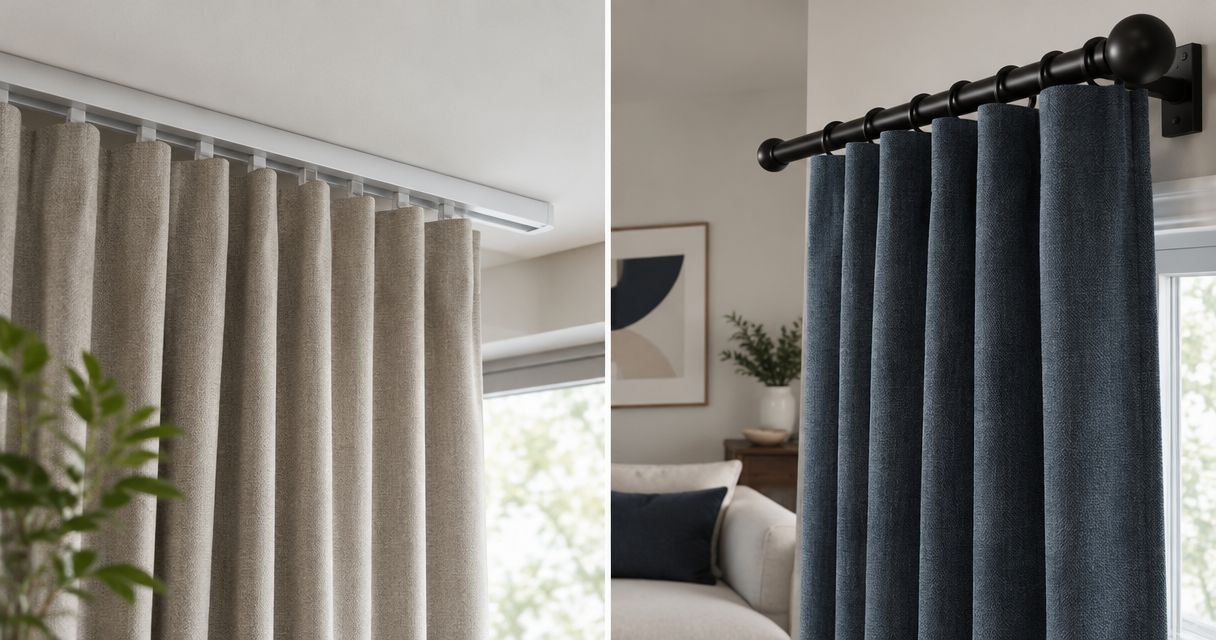
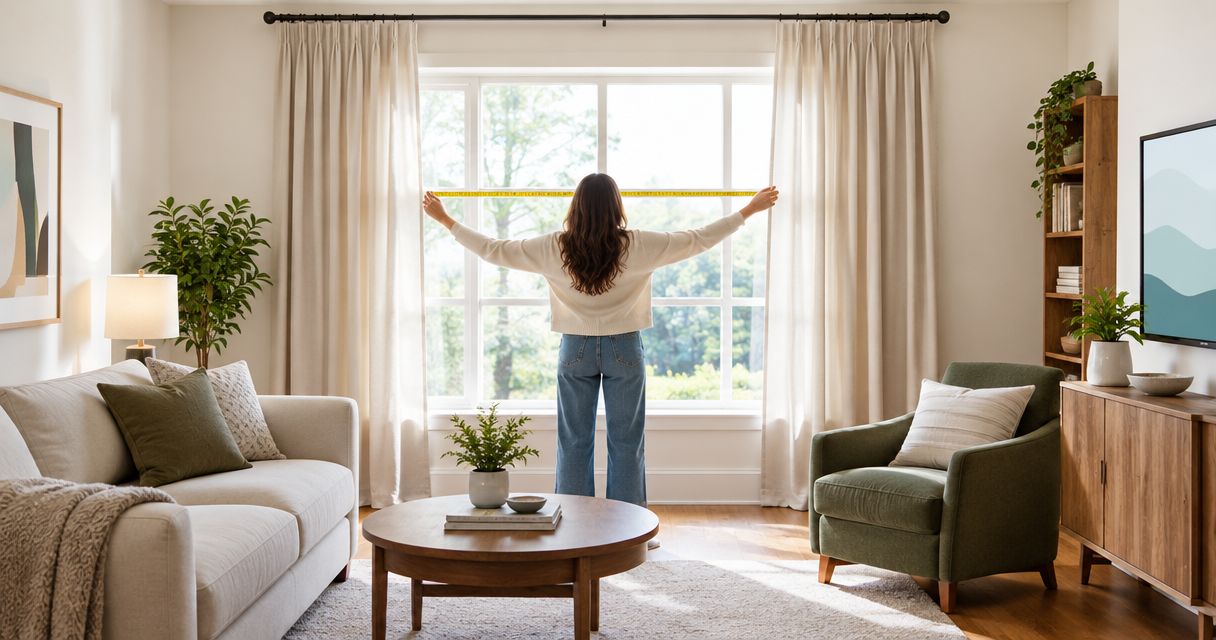
You need enough curtain panels to cover the full rod or track width at the fullness required by your chosen heading—not a fixed number based on the window being large. Divide the required total flat fabric width by the flat width of each panel, then round up. Check whether the listed width describes flat fabric or finished hanging coverage before you order, because those measurements are not interchangeable.
- Curtain-store guidance: how many curtain panels do I need for a large living room window? Calculate coverage before quantity.
- Use the rod or track width, not just the glass width, when planning curtain coverage.
- Flat panel width and finished hanging coverage require different calculations.
- Count sheer and opaque curtain layers separately; each layer needs its own coverage.
How many curtain panels do I need for a large living room window?
Calculate your curtain panel count from the width you need to cover and the way the fabric will hang. A wide window can use a custom-made pair or several narrower ready-made panels; the right arrangement depends on their actual coverage.
For your 2026 curtain order, follow this sequence:
- Measure the rod or track. Use the intended curtain span rather than the glass alone.
- Confirm the heading. Ask whether the stated panel width is flat fabric width or finished hanging width.
- Calculate the required width. For flat fabric, multiply the curtain span by the fullness specified for that heading.
- Divide by individual panel width. Round up to a whole panel, then check the opening arrangement.
- Check each layer independently. Sheers and opaque curtains need separate calculations.
| Width information you have | Calculation to use | Check before ordering |
|---|---|---|
| Flat fabric width per panel | Curtain span × specified fullness ÷ panel width | Confirm the heading’s fullness requirement |
| Finished hanging coverage per panel | Curtain span ÷ finished panel coverage | Confirm whether overlap and returns are included |
| Custom-made curtains for a stated track width | Agree the finished coverage and opening arrangement | Confirm how the maker divides the curtain into panels |
If you want help choosing between ready-made and custom curtains, Curtain-store offers both, along with installation services in Riyadh. Start with your measurements and a photograph of the window so the conversation stays focused on fit.
Why this matters
Panel count tells you how many pieces you are buying; coverage tells you whether those pieces fit. Buying additional panels without checking width can leave you with awkward joins, an uneven opening, or more fabric than the arrangement needs.
Too little usable width pulls the curtain flat when closed. More fabric creates a fuller appearance, but also needs somewhere to gather when the curtains are open.
For a living room, think about the window in both positions. You want privacy when the curtains close and a practical place for the fabric to sit when daylight comes in.
Measure the curtain span before counting panels
Measure the rod or track that the curtains will actually travel along. If you have not installed it yet, decide its intended position before treating any panel count as final.
The glass width alone does not describe the whole curtain arrangement. Your design might extend beyond the window frame, cover a wider recess, or use a ceiling-mounted track across part of the wall.
Write down these measurements separately:
- Curtain span: The width the closed curtain must cover.
- Hanging height: The distance from the relevant hanging point to your chosen finishing point.
- Side space: The wall area available for open curtains to gather.
- Obstructions: Handles, furniture, doors, or other objects that affect movement.
Height does not determine panel count directly, but it determines whether the panels you choose fit the room. A correct width calculation does not rescue a curtain that finishes at the wrong height.
Use the window measurement guide for custom curtains before finalizing your 2026 order. Keep the measurement method consistent from your notes through to the order confirmation.
Understand flat width versus finished coverage
Flat fabric width is the material’s width before it is gathered; finished coverage is the width it covers when hung as intended. This distinction is the most important detail in your calculation.
For a heading that gathers flat fabric into folds, the fabric needs to be wider than the space it covers. The specified fullness expresses that relationship. Ask for the requirement for the actual heading rather than applying a general multiplier to every curtain.
A finished pleated curtain can instead be described by its hanging width. Multiplying that finished width by a fullness allowance again would count the gathering twice.
Check the wording on the product information or written quotation:
- Does the width refer to an individual panel or the complete set?
- Is it measured flat or with the heading formed?
- Does finished coverage include the intended overlap?
- Are side returns included in the measurement?
If the description does not answer these questions, confirm them before buying. A photograph of a full-looking curtain cannot tell you its usable coverage.
Two panels: a pair sized for your curtain span
A pair suits a center-opening layout when each panel covers its assigned share of the span. The important condition is sufficient width, not simply having a panel on either side.
A custom-made pair lets the maker plan the finished widths around your window. Ready-made panels work too when their dimensions and heading provide enough coverage.
The advantage is a straightforward opening arrangement with fewer separate pieces to handle. The limitation is that each panel must be wide enough, and the gathered fabric still needs room at the sides.
Do not assume a pair advertised for a large window will fit every large window. Match the actual dimensions to your own curtain span and check whether the listing describes individual panels or a complete pair.
Four panels: narrower pieces grouped across the opening
Four panels can serve a center-opening arrangement when the combined coverage is sufficient and the pieces are divided evenly between the sides. This is a layout option, not a default recommendation for every wide window.
Several narrower ready-made panels let you build up the required width without relying on a single wide panel on each side. The trade-off is additional meeting edges and more individual pieces to arrange.
| Arrangement | Suited to | Advantage | Limitation |
|---|---|---|---|
| A correctly sized pair | A center-opening curtain with adequate panel widths | Fewer separate pieces to handle | Each panel needs sufficient coverage |
| Several narrower panels | A ready-made arrangement built from individual pieces | Width can be assembled from matching panels | Additional meeting edges need attention |
| A custom-made layout | A window needing an agreed finished fit | Panel division can follow the intended opening | Requires clear measurements and order details |
For your 2026 room plan, sketch where every panel will sit when open. That simple check exposes a layout that fits on paper but crowds the usable opening.

Count sheer and opaque curtains separately
Layered curtains need separate coverage checks because each layer has its own job and hanging arrangement. Do not add a sheer panel to an opaque panel and treat their combined width as complete coverage for either layer.
Sheers soften daylight but do not provide dependable nighttime privacy when the room is lit. An opaque layer addresses a different need, so decide whether both layers must close fully across the window.
Check the heading and finished width for each layer independently. Even when the layers share the same window span, their required fabric widths need not be identical.
Also confirm that the proposed hardware accommodates the intended arrangement. Planning layers before ordering is simpler than discovering afterward that the chosen mounting arrangement does not support how you want to use them.
Why curtain panel counts vary
The answer changes because curtain systems turn fabric width into hanging coverage differently. These are the factors to settle before choosing a quantity:
- Curtain span: A wider rod or track requires more total coverage.
- Panel width: Narrower panels require more pieces for the same finished coverage.
- Heading and fullness: Gathered fabric and finished pleats must be calculated using the appropriate width description.
- Opening direction: Center-opening and side-drawing curtains distribute the fabric differently.
- Layers: Sheer and opaque curtains each need their own complete plan.
- Overlap and returns: The meeting point and side treatment affect the finished coverage requirement.
Fabric choice also affects how the curtain gathers and handles. Ask the maker to consider the chosen fabric with the heading rather than treating the same quantity of every material as interchangeable.
What should you confirm before placing an order?
Confirm the coverage in writing, not just the number of panels. For a 2026 order, your notes should make it possible to check that the delivered arrangement matches what you intended.
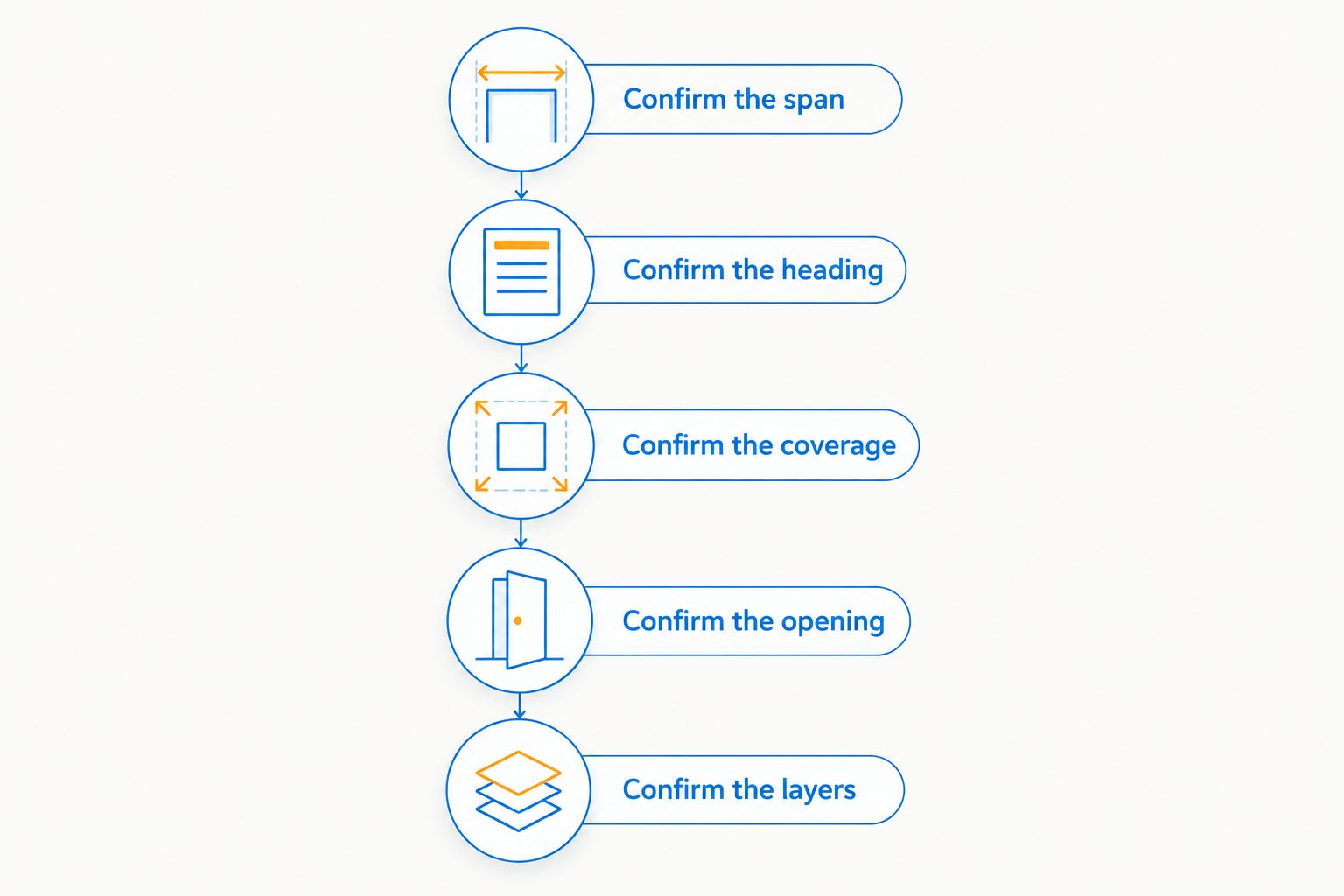
Use this sequence when speaking with the seller or installer:
- Confirm the span. State which rod or track measurement the curtains must cover.
- Confirm the heading. Name the chosen heading and clarify how its width is measured.
- Confirm the coverage. Check total closed width, overlap, and side treatment.
- Confirm the opening. Agree where the panels meet and where they gather.
- Confirm the layers. List each layer separately, including its panel quantity.
A short written summary prevents a conversation about a pair of curtains from becoming ambiguous. Include the finished length as well, even though length is separate from the panel-count calculation.
Can I use a pair on a very wide window?
A pair works when its finished coverage matches the full curtain span and the intended overlap. Custom widths can accommodate a different arrangement from standard ready-made pieces, so window size alone does not settle the question.
Check handling and side space too. Wider individual panels put more fabric into each moving section.
Should I round up the calculated panel count?
Round up to a whole panel, then check whether the resulting quantity suits the opening layout. You cannot buy a fraction of a standard panel, but simply rounding up does not guarantee a balanced center-opening arrangement.
If the calculation and layout do not agree, reconsider the panel width or ask about custom sizing. Avoid adding fabric without a plan for where it will gather.
Does a wider window need more curtain fabric or more panels?
A wider curtain span needs more total coverage, but not necessarily more separate panels. Wider custom panels and additional narrower panels are different ways to achieve that coverage.
Choose based on fit and everyday use rather than panel count alone. The arrangement should close properly and open without obstructing the parts of the room you use.
FAQ
How many curtain panels do I need for a large living room window?
Divide the required total curtain width by the usable width of each panel, then round up and check the opening layout. Use the heading’s specified fullness when calculating from flat fabric width.
Do I measure the window glass or the curtain rod?
Measure the intended curtain rod or track span for the width calculation. Glass width alone does not include any additional curtain coverage beyond the frame.
Does a curtain pair mean each panel has the listed width?
A pair description alone does not tell you whether the listed width applies to each panel or the complete set. Confirm that detail before calculating coverage.
Can I combine several ready-made panels on a wide window?
You can combine matching ready-made panels when their total coverage suits the curtain span. Check the additional meeting edges and how the panels gather when open.
Do sheer curtains count toward my blackout curtain width?
Sheer curtains do not count toward the opaque layer’s required width. Calculate each layer separately if you want each to close across the window.
Should I buy more panels for extra privacy?
Correct coverage and suitable fabric matter more than panel quantity alone. Check the center meeting point, side gaps, and fabric opacity rather than assuming extra pieces solve privacy concerns.
Can Curtain-store help with custom curtains in Riyadh?
Curtain-store offers custom curtains and installation services in Riyadh. Call to discuss your window measurements, preferred opening arrangement, and the measurement support you need before ordering.
One last thing
Photograph the window with the curtains imagined open—not only closed. Mark the gathering areas on your sketch and check nearby handles, furniture, and doorways before approving the arrangement.
For your 2026 curtain project, choose coverage first, panel quantity second. You want a curtain that feels comfortable to use every day, not just one that reaches across the window.