
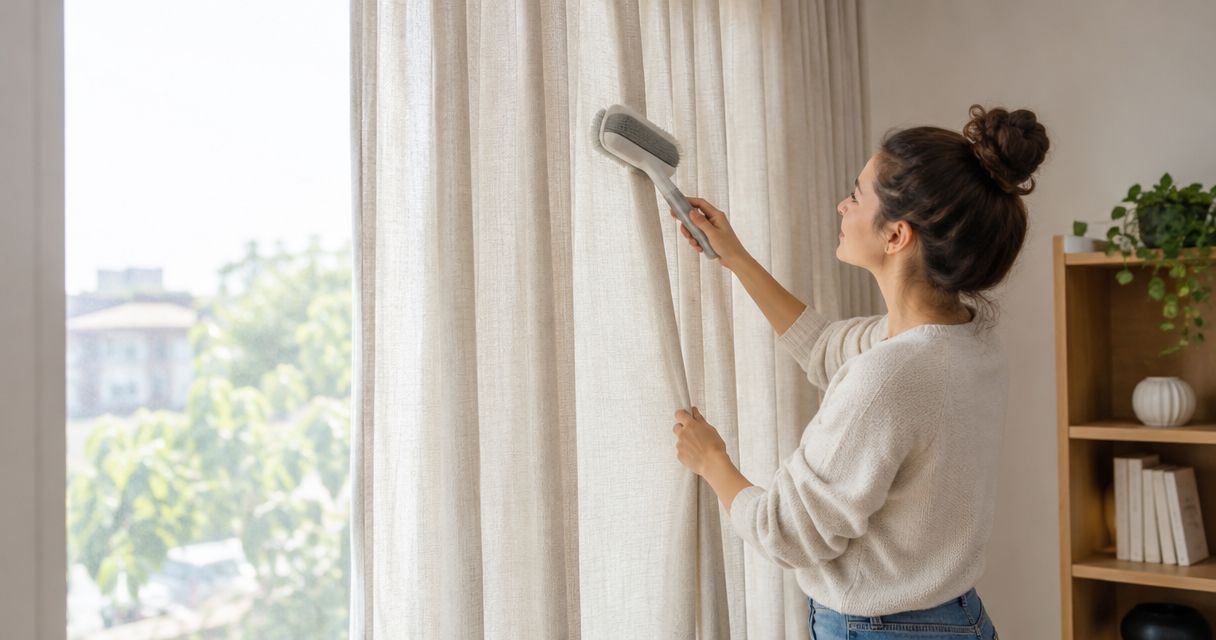
Yes, curtains can be cleaned without removing them from the rod when you are removing loose dust or treating a small mark using a method permitted by the care label. For your 2026 curtain-care routine, treat vacuuming as surface maintenance—not a replacement for washing or professional cleaning when dirt, stains, or odours remain.
- Can curtains be cleaned without removing them from the rod? Yes, for surface dust and label-approved spot cleaning.
- Vacuum gently with an upholstery attachment; stop if the fabric pulls, sheds, or catches.
- Steam is not suitable for every curtain, lining, or blackout coating.
- Curtain-store offers custom curtains and installation support in Riyadh; confirm cleaning requirements before choosing fabric.
Can curtains be cleaned without removing them from the rod?
Yes for routine surface care; no as a substitute for every type of deep cleaning. The right method depends on the complete curtain, including its lining, backing, trim, and care instructions—not just the fabric you see.
Use this comparison to choose your starting point in 2026. If you have coated curtains, read the guide to washing blackout curtains at home before applying water or heat.
| Method | Best for | Main benefit | Main limitation |
|---|---|---|---|
| Gentle vacuuming | Loose surface dust on suitable, sound fabric | Keeps curtains hanging and avoids wetting them | Does not wash out embedded dirt or stains |
| Label-approved spot cleaning | A small, isolated mark | Treats the affected area without wetting the whole panel | Can leave a ring or change the colour or texture |
| Label-approved steaming | Creases on fabric that tolerates steam | Reduces wrinkles while the curtain hangs | Heat and moisture can damage unsuitable materials |
| Removal for specified cleaning | Curtains needing a full clean | Allows the care-label washing or cleaning method | Requires taking down and rehanging the curtains |
Do not combine these methods automatically. A curtain suitable for vacuuming is not necessarily suitable for spot cleaning or steaming.
Why this matters
Cleaning curtains in place lets you keep your window covering up while you deal with everyday dust. The risk comes from treating a lined, coated, or decorated curtain as though it were a plain washable cloth.
For Riyadh homeowners planning curtains in 2026, easy care belongs in the fabric-selection conversation alongside privacy and light control. Curtain-store serves Riyadh homeowners seeking custom curtains and installation support. Ask about the care requirements of the complete curtain before choosing the fabric and lining.
The same principle applies to offices and other business spaces. Keeping curtains hanging is convenient, but convenience should not override fabric instructions or workplace cleaning requirements.
How do you clean curtains while they are hanging?
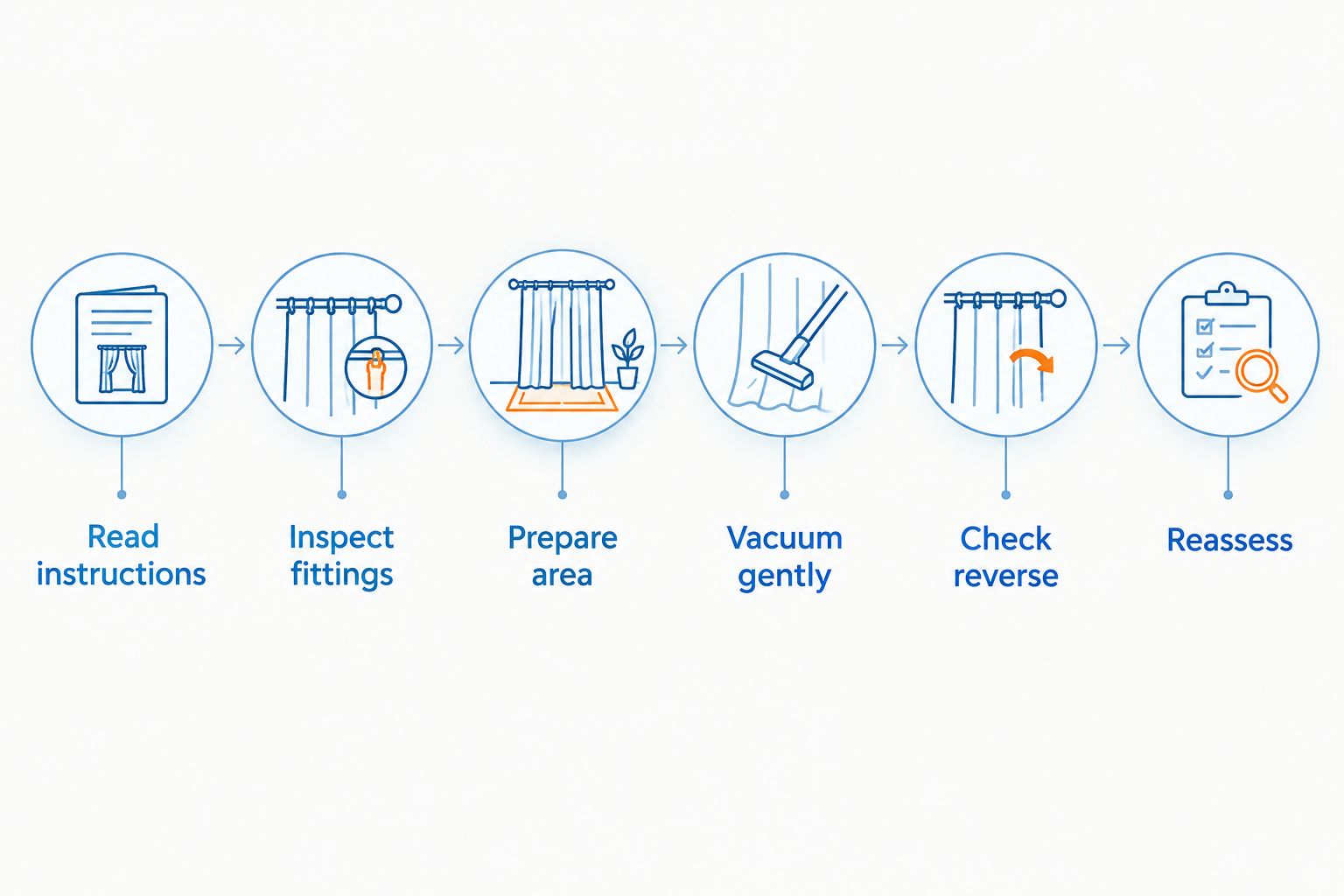
Use the following 6 steps for dry surface cleaning. Do not start with water, fragrance spray, or steam: first establish what the curtain allows and whether the fabric is sound enough to handle.
1. Read the care instructions
Look for the label on the curtain and any care information supplied with it. Check for restrictions on washing, professional cleaning, ironing, and other treatments.
Do not interpret a washing symbol as permission to use a handheld steamer. Follow the curtain instructions and the cleaning appliance instructions together; if either rules out the treatment, do not use it.
If instructions are missing, avoid experimenting with moisture or heat. Identify the fabric and construction with the supplier or a professional curtain cleaner first.
2. Inspect the fabric and fittings
Check hems, pleats, seams, trims, and the fabric near the window. Look for loose threads, tears, powdery coatings, or areas that appear brittle.
Also check that the rod or track is secure before touching the curtains. Do not pull against the curtain to reach higher sections, and do not use a chair or windowsill as a working platform.
3. Prepare the area
Move nearby objects and protect surfaces from falling dust. Keep the curtain accessible without stretching it tightly or putting strain on hooks and rings.
If you need to reach beyond a comfortable standing height, use suitable access equipment or leave that section to someone equipped for the work. Heavy or tall curtains are not worth a fall.
4. Vacuum gently from the top down
Use a clean upholstery attachment and a low suction setting where your vacuum allows adjustment. Support the fabric with your free hand, keeping fingers clear of the attachment.
Work down the accessible folds without pressing hard or dragging across embroidery and trim. Stop immediately if the fabric catches, stretches, sheds, or pulls into the nozzle.
5. Check the reverse and lower edges
Clean the accessible reverse side only if you can reach it without twisting the curtain or loading the fittings. Pay attention to folds and hems where dust has collected.
Treat a separate sheer panel as a separate cleaning task. Do not press it against the heavier curtain behind it and assume both layers can tolerate the same suction.
6. Reassess before adding another treatment
Step back and inspect the curtain in good light. If dust was the problem and the fabric now looks clean, stop there.
A remaining stain, greasy patch, or persistent smell calls for a different decision—not stronger suction or repeated rubbing. Check the approved cleaning method before doing anything else.
Vacuuming: for loose surface dust
Gentle vacuuming is the most straightforward dry-care option when the curtain and attachment are suitable. It removes loose material without introducing water, but it does not make a stained curtain fully clean.
Use suction to lift dust, not force to scrub fabric. An attachment that works well on upholstery can still catch a loose weave or decorative thread, so start cautiously in an inconspicuous area.
Avoid vacuuming visibly damaged fabric or a backing that is flaking. Further handling can worsen the damage; cleaning cannot repair a deteriorating coating or weakened textile.
Spot cleaning: for an isolated mark
Spot cleaning is appropriate only when the care instructions permit it. Remove loose dust first, then test the approved treatment in a hidden area and let that test dry completely before checking for a change.
Use a clean white cloth and the permitted cleaning solution. Blot rather than scrub, keep moisture controlled, and avoid soaking through to the lining or backing.
Stop if colour transfers, a ring develops, or the texture changes. Do not chase a growing water mark across the panel with more liquid; seek advice on cleaning the whole curtain by its specified method.
For an unidentified stain, avoid mixing household cleaners. Tell a professional cleaner what caused the mark, if known, and what you have already applied.
Steaming: for permitted wrinkle treatment
Steaming and washing do different jobs. Steam can relax creases in suitable curtains, but passing a steamer over fabric does not rinse away dirt or remove every stain.
Check both the curtain's care instructions and the steamer manual. Follow the appliance's stated settings and working distance rather than applying a universal distance to every fabric.
Keep steam away from electrical controls, motors, sockets, and other fittings. Do not use steam on a lining, coating, adhesive detail, or trim unless its suitability is confirmed.
After any permitted steam treatment, allow the curtain to dry fully before gathering it into dense folds. Do not describe household steaming as disinfection unless a validated process supports that claim.
Why the right cleaning method varies
The visible face fabric is only part of the decision. These factors explain why curtains hanging side by side can need different care:
- Care instructions: The specified method takes priority over a general cleaning tip or the name of the fibre.
- Lining and backing: A washable-looking face fabric does not establish that the complete curtain tolerates water or heat.
- Trims and construction: Embroidery, attached decorations, pleats, and joined materials need consideration before treatment.
- Fabric condition: Tears, loose threads, brittleness, and deteriorating coatings are reasons to stop and assess the curtain.
- Type of dirt: Loose dust, food grease, a drink spill, and persistent odour are different problems; surface cleaning does not address them equally.
- Access and fittings: Tall windows, heavy panels, and motorized tracks add handling and electrical precautions.
For your 2026 care plan, record the instructions for each curtain type rather than relying on a single household routine. Keep the information with your order details so anyone cleaning the room can follow it.
Can blackout curtains be cleaned while hanging?
Yes, suitable blackout curtains can receive gentle surface care while hanging, but the backing needs its own check. The word blackout describes light control, not permission to wash, steam, or spot-clean.
Inspect the reverse before treatment. If you see flaking, peeling, or separation, stop rather than rubbing the area or applying heat.
For layered window treatments, check every layer separately. A decorative front panel and blackout lining do not automatically share the same care requirements, even when they hang together.
Does steaming curtains clean them completely?
No, steaming curtains does not replace the washing or professional cleaning specified for a full clean. Treat permitted steam as wrinkle care, not proof that stains, grease, allergens, or microorganisms have been removed.
If the curtain still smells or looks dirty after surface care, reconsider the method. Repeated steaming adds moisture without necessarily solving the underlying problem.
When should you take curtains down instead?
Take curtains down when their prescribed cleaning method requires removal, when the whole panel needs cleaning, or when safe access is not possible while they hang. Follow instructions for removing hooks and other fittings, and arrange help for heavy panels.
Seek professional advice for persistent stains, unknown care requirements, delicate decoration, visible mould, or damaged backing. Do not simply cover an odour with fragrance; inspect the curtain and surrounding area for its source.
Before removal, photograph the hanging arrangement and keep each panel's fittings together. This makes reassembly clearer without relying on memory, especially where different windows use different hooks or tracks.
Choosing curtains with everyday care in mind
If you are ordering in 2026, ask how you will clean the finished curtain—not just the sample fabric. Explain whether you want routine care while it hangs, whether the window is difficult to reach, and who will handle a full clean.
Curtain-store offers ready-made and custom curtains, blinds, fabrics, and installation services for homeowners and businesses. Discuss care requirements alongside your privacy, appearance, and installation needs; do not assume that installation support includes a cleaning service.
Prefer to talk through your window? Call the store using its published contact details, with WhatsApp as a secondary option, and confirm the appropriate contact route before sending your enquiry.
FAQ
Can I vacuum my curtains without taking them down?
Yes, if the fabric is sound and suitable for gentle vacuuming. Use a clean upholstery attachment, reduce suction where possible, and stop if the fabric catches, stretches, or sheds.
Can I clean curtains while they hang if the label says dry clean only?
Do not use water-based spot treatments or steam on dry-clean-only curtains without professional advice. Ask whether gentle dry dust removal is suitable for the particular fabric and its condition.
Will a handheld steamer remove stains from curtains?
A handheld steamer is not a general stain-removal solution. Use it for wrinkles only when the curtain and appliance instructions permit, and choose a label-approved treatment for stains.
Can I spray fabric freshener on curtains instead of washing them?
Fabric freshener does not replace cleaning. It does not remove accumulated dirt, and any spray needs to be suitable for the complete curtain, including its backing and trim.
How often should I clean curtains while they are hanging?
Follow the care instructions and inspect for dust, marks, and changes in condition rather than relying on a universal schedule. Arrange the specified full clean when surface care no longer addresses the problem.
Can I clean motorized curtains without removing them?
Gentle surface care is possible when the fabric and system instructions allow it. Follow the manufacturer's power-safety instructions and keep liquids and steam away from motors, controls, and electrical connections.
Should sheer curtains and lined curtains be cleaned the same way?
No, sheer curtains and lined curtains need separate care checks. Weave, construction, backing, and condition determine the method; sharing a window does not make their cleaning requirements identical.
One last thing
Keep a photograph of the care label before it becomes difficult to read. Include the reverse of the curtain and any supplied care sheet, then save them with the room name and order details.
For curtains ordered in 2026, this simple record gives you a useful starting point when a stain appears later. Curtain-store customers can also ask about care requirements during fabric selection, when changing the material or lining is still part of the decision.