
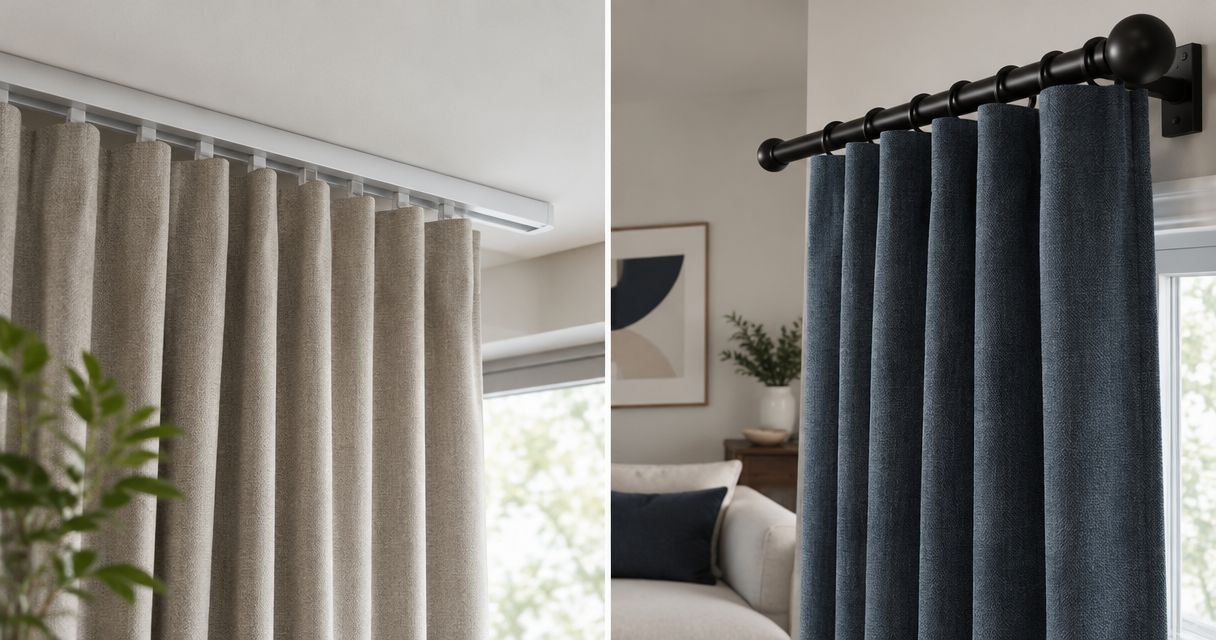
For heavy fabrics, choose a curtain track when you want concealed hardware and an uninterrupted opening path; choose a curtain rod when visible decorative hardware matters more. Neither is stronger by name alone: the complete system must support the finished curtains at your window width, with fixings suited to the wall or ceiling.
- Is a curtain track or a curtain rod better for heavy fabrics? Choose by load rating, support layout, and operation.
- Curtain tracks suit concealed hardware; curtain rods suit a visible decorative finish.
- Heavy curtains need compatible carriers or rings, secure brackets, and a suitable fixing surface.
- Curtain-Store offers custom curtains and installation services for Riyadh homeowners and businesses.
Is a curtain track or a curtain rod better for heavy fabrics?
A suitably rated track is the practical choice for concealed, frequently operated heavy curtains; a suitably rated rod suits rooms where the hardware forms part of the design. The deciding evidence is the manufacturer's specification for the complete installation—not whether the fitting looks thick or feels substantial.
For your 2026 curtain project, compare the hardware with the actual fabric, lining, heading, and opening width. The curtain rods and tracks guide gives you a starting point for understanding both options.
| Decision | Curtain track | Curtain rod |
|---|---|---|
| Best suited to | Concealed hardware and an uninterrupted travel path | Visible decorative hardware and coordinated rings or eyelets |
| Main advantage | Compatible carriers travel within a guided channel | The pole and finials become part of the room's finish |
| Main limitation | Carriers, hooks, and track must work together | Conventional rings cannot pass a standard centre support |
| Heavy-fabric check | Confirm the track, carriers, brackets, and fixing specification | Confirm the pole span, brackets, rings, and fixing specification |
| Before ordering | Check how the curtains open and where they stack | Check whether supports interrupt the intended opening movement |
Neither option gets a blanket recommendation for every room. A correctly specified rod is a better choice than an underspecified track, and the reverse is equally true.
Why this matters
Heavy curtains place demands on more than the visible rail. The load travels through hooks or rings, carriers, brackets, screws, and the supporting surface; choosing only the fabric and decorative finish leaves essential decisions unresolved.
For a Riyadh bedroom, you might want lined curtains that close comfortably every evening. For a majlis, the visible pole might be part of the design. For a business interior, repeated operation and access for maintenance deserve attention alongside appearance.
Choose the fabric and hardware together. That gives you a clear way to discuss privacy, comfort, curtain movement, and installation before the order is final.
Curtain tracks: suited to concealed hardware and clear travel
A track guides curtains using compatible carriers inside a channel. Depending on its design and installation, the track can sit visibly against the wall or ceiling, or be concealed within a suitable recess.
The practical advantage is the opening path. Unlike conventional rings meeting a standard rod bracket, compatible track carriers follow the channel without that particular obstruction. Confirm that joints, bends, and supports belong to the intended system rather than assuming every track works the same way.
Where a track makes sense
Choose a rated curtain track when you want:
- A discreet finish that lets the fabric take visual priority.
- Curtains that travel across a wide opening without conventional rod brackets interrupting the rings.
- A ceiling-mounted arrangement, where the supporting structure permits it.
- A compatible heading and carrier arrangement selected as one system.
What to check before choosing a track
A track is not automatically suitable for heavy velvet or lined drapes. Ask for the load specification, approved support spacing, compatible carriers, and fixing requirements for the proposed installation.
Also check access. If the track sits inside a recess, you still need a practical way to remove curtains and reach components for maintenance. Concealment should not make routine care unnecessarily difficult.
Choose a track for its verified specification and travel path—not because concealed hardware is assumed to be stronger.
Curtain rods: suited to a visible decorative finish
A rod makes the hardware part of the room. The pole, brackets, finials, and attachment style remain visible, so their proportions matter alongside the curtain fabric.
A properly specified rod can support heavy curtains. Its suitability depends on the complete arrangement, including material, construction, unsupported span, bracket layout, and fixing surface; diameter alone does not settle the question.
Where a rod makes sense
Choose a rated curtain rod when you want:
- Visible hardware that complements the room.
- A heading designed for the chosen pole or rings.
- An opening layout that works with the required supports.
- Accessible hardware for removing and rehanging curtains.
What to check before choosing a rod
Check where each curtain panel needs to travel. With a conventional rod, a standard centre bracket stops ordinary rings from crossing it, so the support layout must match the opening arrangement.
Some specialist systems use compatible passing brackets and rings. Do not assume these parts are interchangeable with ordinary components, and do not remove a required bracket simply to let a curtain travel farther.
Choose a rod when the visible finish matters and its supported span suits your curtains. Keep structural support ahead of an uninterrupted pole appearance.
Why suitability varies
For a 2026 purchase, use these factors to compare the proposed systems. They explain more than a broad label such as heavy-duty.
- Finished curtain weight: Include the main fabric, lining, interlining where used, and attached heading components. The fabric name alone does not establish the load.
- Opening width: A longer unsupported span changes the support requirements. Check the specification at your intended installation width.
- Fixing surface: Concrete, masonry, timber, and plasterboard require different fixing decisions. Decorative finishes do not reveal the structure behind them.
- Heading compatibility: Eyelets, rings, hooks, and carriers need hardware designed to accept them. Select the heading before finalising the system.
- Opening pattern: Decide whether curtains meet in the middle, draw to one side, or operate as separate sections. Supports must suit that movement.
- Clearance and stacking: Allow space for gathered fabric, handles, nearby walls, and any additional curtain layer. Weight capacity alone does not establish a good fit.
How do you choose hardware for heavy curtains?
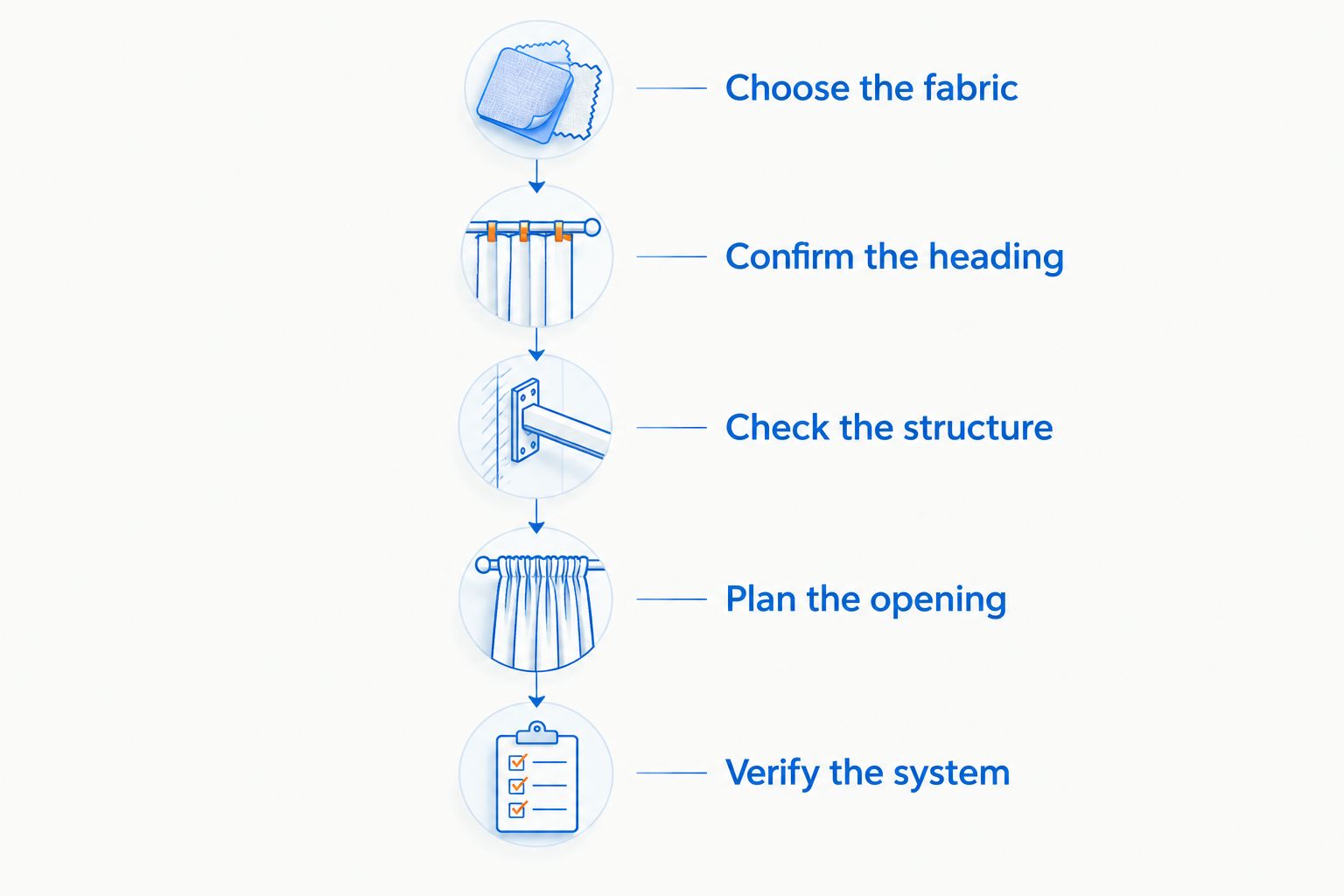
Start with the finished curtain design, then confirm the mounting position and hardware specification. This sequence prevents you from buying a pole or track that cannot accommodate the heading, opening pattern, or available support.
- Choose the fabric. Decide whether the curtain includes a lining or additional layer, and establish the finished curtain weight before hardware approval.
- Confirm the heading. Match the intended curtain attachment to the proposed rings, hooks, or carriers.
- Check the structure. Identify where the brackets can be securely fixed and whether the wall or ceiling needs further assessment.
- Plan the opening. Mark the direction of travel, meeting point, and stacking position for each curtain.
- Verify the system. Confirm load suitability, support spacing, component compatibility, and access for maintenance.
Take photographs of the window, ceiling edge, and surrounding furniture when discussing your project. Include nearby doors, air-conditioning outlets, and handles so the installation conversation covers the whole space rather than just the glass.
Curtain-Store serves Riyadh homeowners and businesses seeking custom curtains and installation support. Call to discuss the fabric, heading, and mounting arrangement together; confirm the measurement arrangements and installation scope before placing your order.
What should you ask before approving installation?
Your 2026 order should describe the hardware clearly enough that you know what will support the curtains. Ask for the proposed system, attachment components, bracket arrangement, mounting surface, and opening direction to be confirmed together.
Use these questions during the discussion:
- Does the stated load suitability apply at this installed width?
- Does it cover the finished curtains, including their lining?
- Which rings, hooks, or carriers belong with this system?
- Will any bracket interrupt the curtain's intended movement?
- How will the installation attach to the supporting structure?
- Can you remove the curtains and access the hardware for maintenance?
For a business installation, add a demonstration of the intended opening and closing routine to the handover discussion. Staff should understand how the selected system operates without pulling against an obstruction.
Can a ceiling-mounted track hold heavy curtains?
A ceiling-mounted track can hold heavy curtains when the complete system and supporting structure are suitable for the load. Ceiling mounting is a position, not a strength rating.
A suspended ceiling or decorative gypsum feature does not, by itself, establish a suitable fixing point. Ask the installer to identify the structural support and the approved fixing method before accepting the proposed position.
For your 2026 room plan, show any curtain recess before fabric production is finalised. Its available space must accommodate the selected track, curtain heading, movement, and maintenance access.
Is a thicker curtain rod always stronger?
A thicker-looking curtain rod is not proof of greater load capacity. Material, wall thickness, construction, span, brackets, and fixings all affect whether the installation suits your curtains.
Ask for the specification of the exact rod rather than comparing appearances. A decorative sleeve or finish tells you little about the structure carrying the fabric.
Can you reuse an existing rod for heavier curtains?
Reuse an existing rod only after checking its specification, condition, supports, and fixings against the new curtains. A fitting that carried lightweight panels has not demonstrated that it can carry heavier lined drapes.
Curtain-Store offers ready-made and custom curtains, so explain which existing hardware you intend to retain when discussing a curtain order. Treat reuse as a compatibility check, not an assumption that the new fabric will work with the old arrangement.
FAQ
Is a curtain track or a curtain rod better for heavy fabrics?
A suitably rated curtain track suits concealed hardware and an uninterrupted travel path; a suitably rated curtain rod suits a visible decorative finish. The complete system must support the finished curtains at the intended width.
Can I hang heavy velvet curtains on a rod?
Yes, a rod can carry heavy velvet curtains when its specification, supports, and fixings suit the finished curtain load. Include any lining rather than judging suitability from the velvet alone.
Will a curtain track stop heavy curtains from sagging?
A curtain track does not automatically prevent sagging. The system still needs the correct load capacity, support spacing, compatible components, and secure installation.
Can heavy curtains hang from plasterboard?
Plasterboard alone does not establish a suitable fixing method for heavy curtains. Have the supporting structure and proposed fixings assessed before installation.
Do heavy curtains need a centre bracket?
The system's specification and installed span determine whether a centre bracket is required. On a conventional rod, standard rings cannot pass through an ordinary centre bracket, so plan the curtain opening around the support layout.
Can I put a sheer curtain and a heavy curtain on the same fitting?
You need a system designed for the intended layers, with suitable clearance and load capacity. Check each layer's travel path and how the combined arrangement attaches to the supporting structure.
Should I choose the fabric or the track first?
Choose the fabric, lining, heading, and hardware together before final approval. The finished curtain design determines the load and attachment requirements.
One last thing
Check where the curtains sit when they are open—not just how they look closed. Heavy fabric gathers beside the window, and the planned stacking position affects access to handles, nearby doors, and the amount of glass left exposed.
Before approving your 2026 order, ask to review the open and closed positions on the same plan. That small design check connects the hardware decision to how you will actually use the room.