Yes, roller blinds can block heat as well as some curtains, but the result depends on the fabric, window coverage and installation—not the name of the treatment. Blackout fabric blocks light, yet darkness alone does not prove thermal performance; compare the backing, edge gaps and any documented solar-control properties before choosing.
- Can roller blinds block heat as well as curtains? Yes, but fabric, backing and fit determine the result.
- Blackout roller blinds control light; blackout alone does not establish heat-insulating performance.
- Lined curtains offer broad window coverage, but gaps still let sunlight reach the room.
- Curtain-store offers Riyadh homeowners custom curtains, blinds and installation support.
Why this matters
A window treatment should make your room comfortable without forcing you to sit in darkness all day. For Riyadh homeowners choosing in 2026, that means separating three needs: reducing incoming solar heat, managing glare and maintaining privacy.
Curtain-store offers ready-made and custom curtains, blinds, fabrics and installation services. Start with how you use the room, then choose the treatment; a bedroom, family living room and customer-facing office do not need the same daylight balance.
Choose for heat control and daily comfort together—not fabric thickness alone. A covering you leave open during direct sunshine cannot provide the same shading as one you actually close.
Can roller blinds block heat as well as curtains?
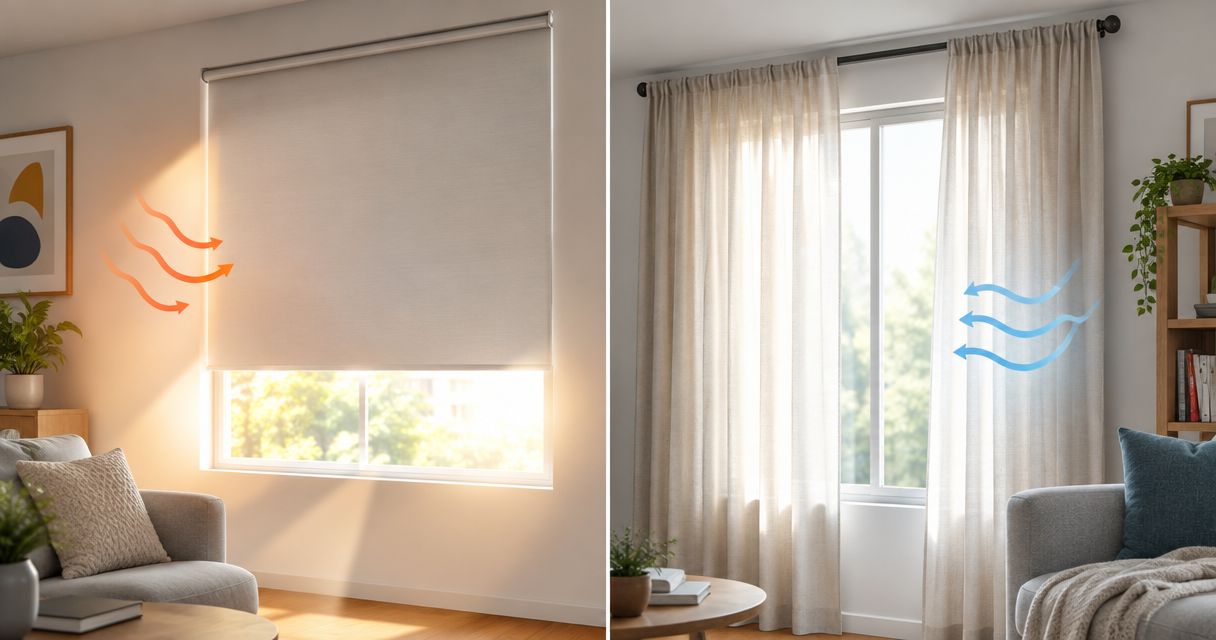
Yes, a roller blind can provide effective solar shading, and a curtain is not automatically better because it looks heavier. Equally, a basic roller blind is not automatically equivalent to a lined curtain with generous coverage. Compare the complete installation rather than two fabric samples.
The U.S. Department of Energy's Energy Saver guidance explains that about 76% of sunlight falling on standard double-pane windows enters to become heat. It also reports that medium-coloured draperies with white plastic backings can reduce heat gains by 33%. These figures describe particular window and drapery conditions; they are not performance promises for every curtain or blind.
For your 2026 comparison, use those figures as a reminder that construction matters. Neither a blackout label nor a photograph establishes how much heat a specific treatment will reduce.
| Window treatment | Best for | Useful strength | Limitation to check |
|---|---|---|---|
| Opaque roller blind | A compact covering with straightforward light control | Covers the glazing without curtain folds | Side gaps and fabric properties affect the result |
| Lined curtain | Broad coverage and a softer room finish | Can extend beyond the window and overlap at the centre | Uncovered edges and an unsuitable lining weaken shading |
| Sheer curtain | Daytime light diffusion | Softens direct light while retaining a bright feel | Does not provide the same light blocking as an opaque covering |
| Roller blind with curtains | Separate control of light and room appearance | Lets you use each layer for a different purpose | Needs enough mounting space and access to both controls |
There is no universal winner in this table. For a sunny window, prioritise documented solar-control properties and complete coverage; for a layered room, assign each covering a clear job.
Roller blinds: compact shading with a fit-dependent result
A roller blind rolls away above the window, leaving a relatively uncluttered opening. That makes it a useful choice when you want simple daily operation or have limited room beside the frame.
The important distinction is between the blind's fabric width and the overall mechanism width. Ask which measurement describes the area that actually covers the glass. A mechanism that fits the opening does not necessarily mean its fabric covers every edge.
An inside-recess installation keeps the blind within the opening, but clearance around the fabric can leave visible strips of sunlight. An outside-recess installation can provide wider coverage, provided the wall, mounting position and surrounding fittings allow it.
Best for: rooms where you want a compact treatment and direct control over daylight. The drawback is that a neat appearance does not guarantee low solar heat gain: backing, fabric properties and uncovered glass still matter.
Ask for any available solar-performance information for the exact fabric under consideration. If the only specification describes light blocking, treat it as evidence about light—not a measured heat-reduction result.
Curtains: generous coverage without an automatic thermal advantage
Curtains give you more freedom to extend fabric beyond the sides of a window. They can also overlap where the panels meet, helping you cover the central opening when closed.
Their thermal usefulness depends on more than the decorative fabric. The lining, window-facing surface, coverage and relationship to the glazing all influence the finished result. Heavy folds alone are not a reliable comparison with a roller blind.
A lined curtain with good coverage is a practical option when privacy and a softer interior finish matter alongside shading. However, a curtain pulled back during direct sunshine is not shading the exposed glass, regardless of its fabric weight.
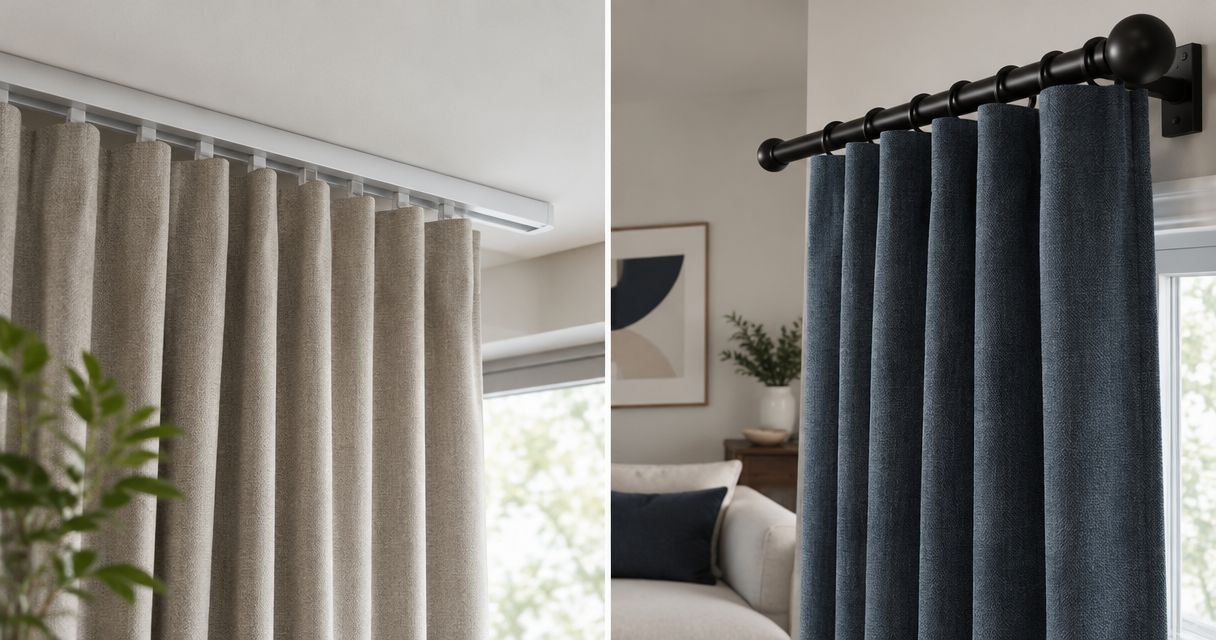
Best for: bedrooms, majlis rooms and living spaces where window coverage and a fabric finish are both priorities. The trade-off is the space needed for the track or rod, the gathered panels and comfortable access around furniture.
For large openings, discuss where the panels will sit when open. You want the curtains to move freely without blocking a door handle or making a seating area awkward to use.
Roller blinds with curtains: give each layer a purpose
Combining a roller blind with curtains lets you adjust the room in different ways. You can use the blind for direct shading and the curtains for additional coverage, privacy or the appearance you prefer.
Two layers do not establish a specific thermal improvement by themselves. A poorly fitted combination still leaves gaps, and adding a sheer curtain does not turn an ordinary roller blind into a tested insulating system.
Before ordering, check whether both treatments can operate without touching each other. The blind needs clearance, while the curtain needs room to hang and travel across its track.
Best for: living rooms and bedrooms where you want separate control over daylight and the decorative finish. The limitation is a more involved installation with additional fabric, hardware and cleaning needs.
A useful starting point is to ask which layer you expect to close during direct sunshine. If neither feels convenient to use, simplify the arrangement before choosing fabrics.
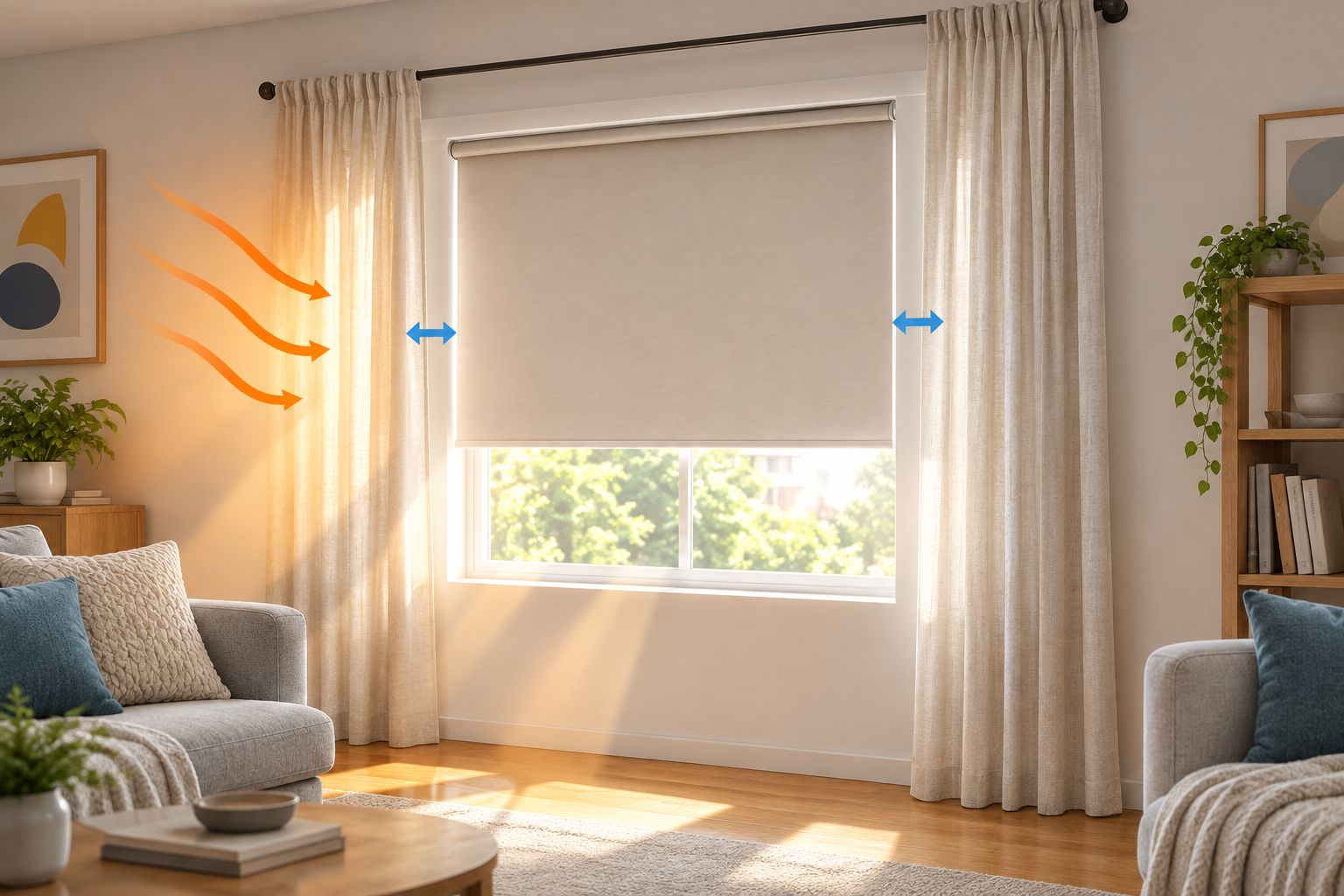
Why heat control varies between windows
The same treatment does not deliver an identical result everywhere. For a 2026 purchase, assess each window rather than choosing one fabric and assuming every room will feel the same.
- Sun exposure: Direct sunshine creates a different shading requirement from a window that receives mainly indirect daylight. Note when sunlight reaches the glass.
- Fabric and backing: Light transmission, reflectance and construction matter. Compare information for the exact material, not a broad category label.
- Coverage and gaps: Exposed glass remains exposed glass. Check the sides, centre opening and lower edge when the treatment is closed.
- Window construction: Glazing and existing window features affect the starting conditions. A curtain or blind cannot replace the window's own thermal properties.
- Daily operation: The treatment needs to be closed while the sun reaches the window. Choose controls you can comfortably reach and use.
- Room requirements: A bedroom prioritises darkness differently from a living room or workspace. Decide how much daylight you want to retain.
Keep glare separate from heat when describing the problem. A bright reflection on a television calls for light control; discomfort beside sunlit glass also calls for attention to solar shading.
How do you choose between roller blinds and curtains?
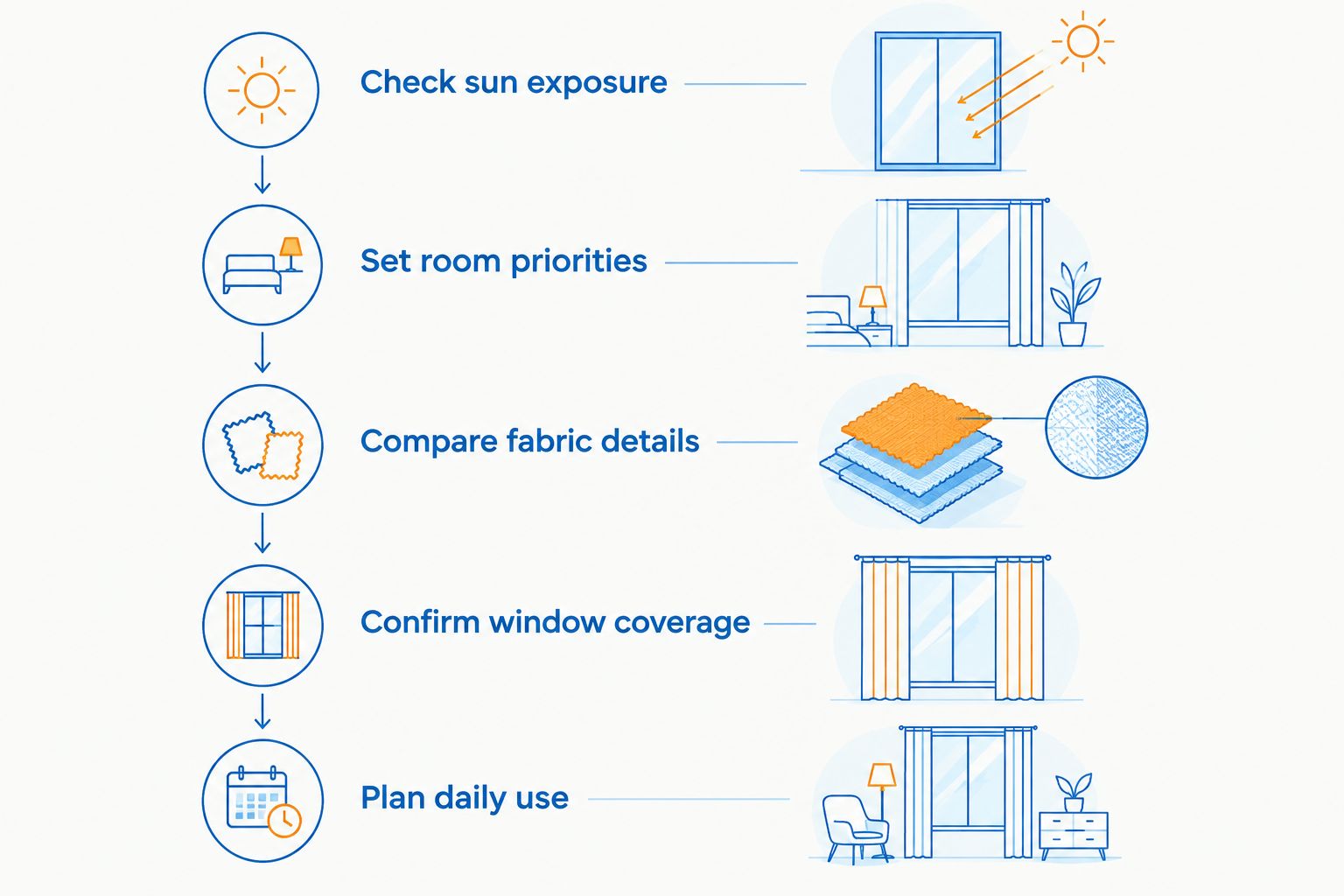
Use these steps before comparing colours. They turn a broad heat-control question into a clear brief for the person measuring and installing your window treatment.
- Check sun exposure. Observe the room when you normally use it. Identify the windows receiving direct sunshine and the places where glare causes discomfort.
- Set room priorities. Decide whether darkness, daytime privacy, a clear view or a soft fabric finish matters most. For offices and shops, include screens and customer-facing areas.
- Compare fabric details. Ask about the window-facing backing and any documented solar-control properties. Do not accept a blackout description as a substitute for thermal information.
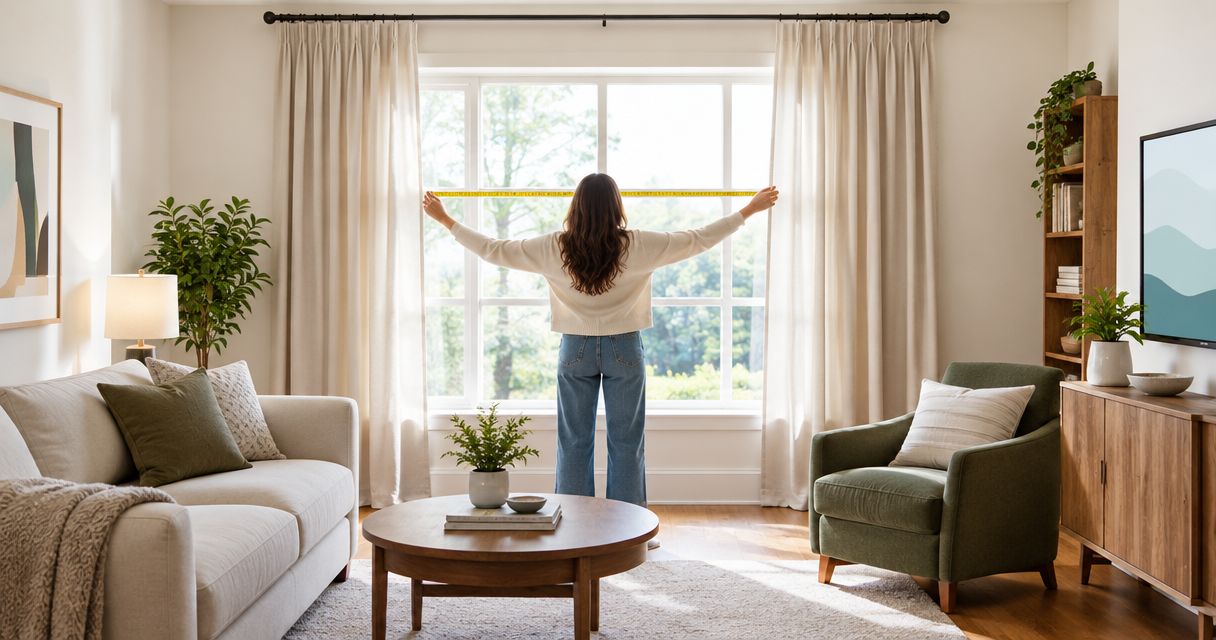
- Confirm window coverage. Discuss fabric width, overlaps, handles, opening windows and the proposed mounting position. Check how the treatment will look and function when closed.
- Plan daily use. Make sure you can reach the controls and move the covering without rearranging furniture. Agree on the installation details before placing the order.
These steps also help when choosing custom curtains. The fabric-selection-to-installation workflow gives you a related planning guide for bringing the material and fitting decisions together.
Does blackout mean a blind or curtain blocks heat?
Blackout means the material is intended to block light; it does not establish a specific reduction in solar heat gain. You still need to consider the backing, coverage and any thermal-performance documentation.
For a 2026 bedroom choice, check both the material and the installed edges. An opaque fabric can leave the room visibly bright if sunlight passes around it.
Should you choose different treatments for different rooms?
Yes, choose according to the room's use and exposure rather than matching every window automatically. A bedroom needs different light control from a workspace where you want daylight without reflections on a screen.
Keep the appearance coordinated through fabric or colour if that matters to you. The practical arrangement can still differ: curtains in one room, a roller blind in another, or a layered treatment where both have a purpose.
What should you ask before ordering in Riyadh?
Ask how the proposed treatment will cover your actual window, what information supports its heat-control properties, and what the installation includes. Confirm measurement arrangements, mounting details and timing before committing.
Curtain-store is suited to Riyadh homeowners who want custom curtains and blinds with installation support. The relevant benefit is getting the fabric and fitting decisions considered together, rather than expecting a category name to solve the problem.
For your 2026 order, call Curtain-store first to discuss your room and window needs; use WhatsApp as a secondary contact route. Describe the sunlight, privacy requirements and any doors or furniture that affect access, then ask about the next step.
FAQ
Can roller blinds block heat as well as curtains?
Yes, roller blinds can block heat as well as some curtains, but fabric properties, backing and coverage determine the result. Compare the complete installation rather than assuming one category always performs better.
Are blackout roller blinds also heat-insulating blinds?
Blackout roller blinds block light, but that label alone does not establish heat-insulating performance. Ask for solar-control information for the exact fabric and check gaps around the installed blind.
Do thicker curtains always keep a room cooler?
Thicker curtains do not automatically provide better solar heat control. The lining, window-facing surface, coverage and whether you close them during sunshine all matter.
Should I use a roller blind and curtains together?
Use a roller blind and curtains together when you want separate control of daylight and the room's fabric finish. Confirm mounting clearance and give each layer a clear purpose rather than assuming extra layers guarantee a particular result.
Will window coverings replace air conditioning in Riyadh?
Window coverings do not replace air conditioning; they help manage sunlight and solar heat entering through windows. Indoor comfort also depends on the building, glazing and cooling system.
Are roller blinds suitable for offices as well as homes?
Roller blinds are a practical option for offices where controlled daylight and a compact treatment matter. Check screen glare, privacy and window access before selecting the fabric.
Can Curtain-store help with custom curtains and installation?
Curtain-store offers custom curtains, blinds and installation services for homeowners and businesses in Saudi Arabia. Call to discuss your requirements and confirm the measurement and installation arrangements for your order.
One last thing
Check the window-facing side of the fabric, not just the side you see inside the room. A decorative colour tells you how the treatment will look; its backing and documented properties tell you more about how to assess it for solar shading.
Before approving the order, ask to see how the proposed covering meets the window edges. That small fitting conversation is more useful than choosing a heavier fabric without checking coverage.