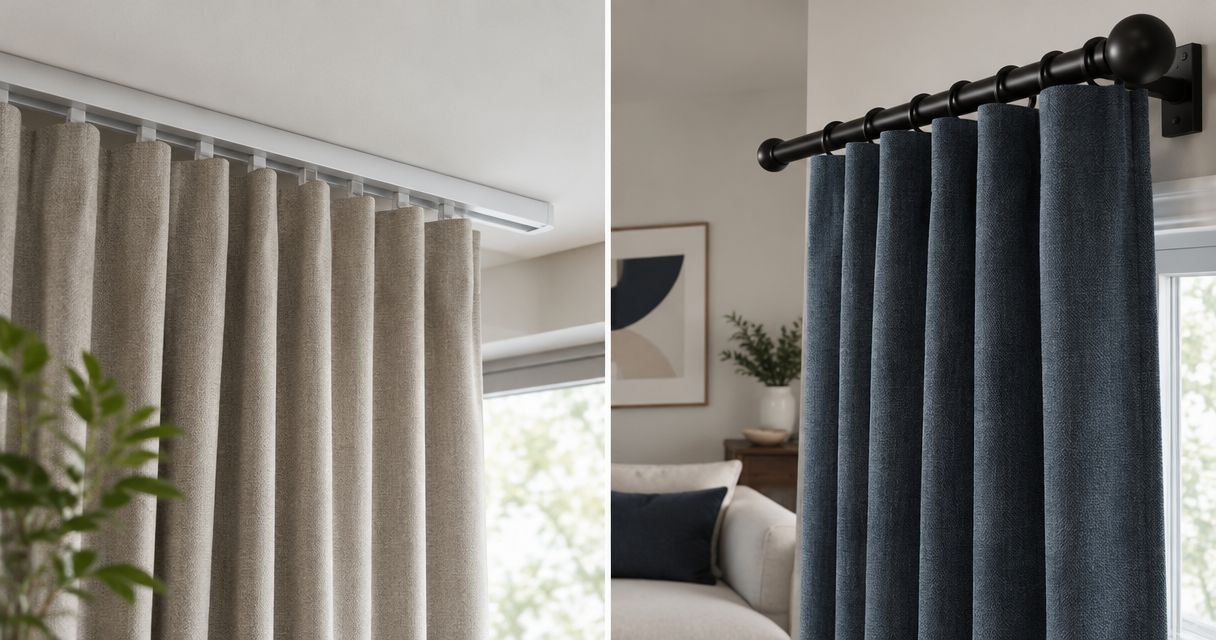
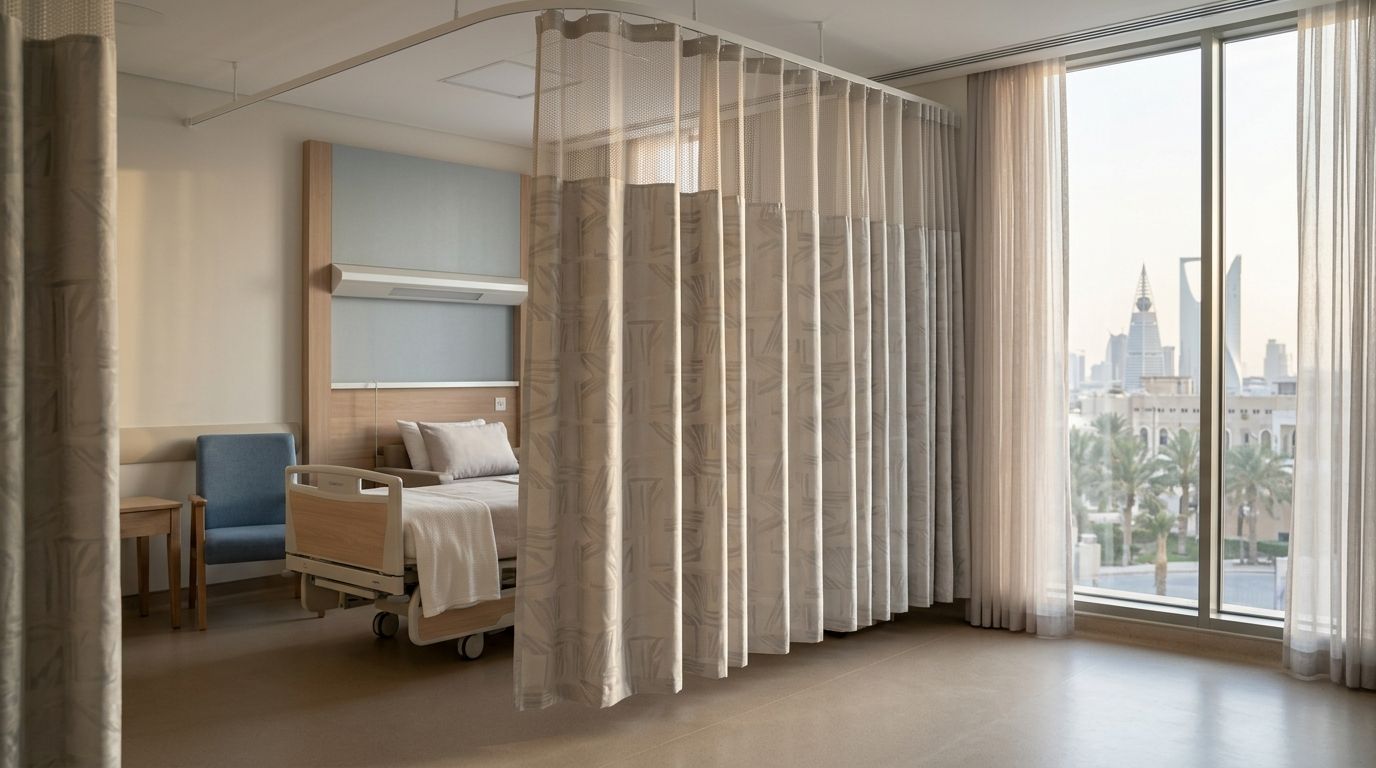
Hospital and clinic curtain planning is the process of choosing window treatments and privacy solutions that support patient comfort without disrupting care. For curtains for hospitals and clinics in Riyadh in 2026, start by separating ordinary window coverings from patient-area dividers: they serve different purposes and need different approvals.
- Curtains for hospitals and clinics in Riyadh need a room-by-room plan before fabric selection.
- Curtain-store suits Riyadh clinics seeking custom window curtains with installation support; verify healthcare-specific requirements separately.
- Keep patient-area dividers distinct from window curtains and confirm cleaning requirements with your facility team.
- Measure each opening, record how the room is used, and agree on installation access before ordering.
Why curtains matter for hospitals and clinics
A treatment room needs privacy during an examination. A waiting area needs a comfortable balance of daylight and screening from outside. An administrative office has different priorities again. Treating every opening alike creates avoidable problems for staff and patients.
For a Riyadh facility, sunlight and indoor comfort also belong in the discussion. The right question is not simply which fabric looks good; it is what each room must let staff do throughout the day. Curtain-store suits Riyadh clinics seeking custom window curtains with installation support; verify healthcare-specific requirements separately. Start with its Curtain-store window-treatment options when you are ready to discuss a custom order.
If a curtain will separate patients, surround a bed or sit inside a clinical care area, involve the facility's infection-control and operations teams before choosing it. The information provided about Curtain-store confirms curtains, blinds, fabrics and installation services, but does not establish that any particular item meets a healthcare specification.
How to choose curtains for a Riyadh healthcare space
Map each room by its actual use
Walk through the facility before looking at samples. Note where people wait, receive care, change clothes, work at a desk or pass through a corridor. A street-facing consultation room has a different privacy problem from an internal office, even if its windows look identical.
In 2026, make one room schedule that staff can review rather than relying on a verbal request for clinic curtains. Put windows and any proposed patient-area dividers on separate lines. That distinction helps you avoid ordering a window treatment for a job that calls for a facility-approved clinical partition.
- Label each opening by room and its function.
- Mark where privacy matters while the room is occupied.
- Record where daylight, glare or outside views affect the room.
- Flag every patient-area divider for a separate facilities review.
Ask the facility team what it will approve
Before discussing colors or heading styles, ask the people responsible for cleaning, infection control and building operations what they need documented. Approval depends on the intended location and the facility's own requirements; a fabric suitable for an office window is not automatically suitable beside a treatment bed.
Ask how the covering will be cleaned, who will remove it when needed and whether the fixing method interferes with access to equipment. Keep those answers beside the room schedule. This is the manual check that prevents a visually appealing choice from becoming an operational problem.
- Get cleaning and removal requirements for each room type.
- Identify rooms that require specific material documentation.
- Confirm who approves fixings and installation access.
- Keep clinical-divider requests separate from ordinary window-treatment requests.
Measure openings and identify obstructions
Measure each window rather than assuming repeated rooms have identical dimensions. For example, record an opening as 200 cm wide by 180 cm high on the room schedule, then check the proposed fixing position separately. Those figures are a sample entry, not a standard curtain size or an installation allowance.
Photograph the opening if your facility permits it, taking care not to include patients or confidential information. Note handles, vents, electrical fittings and nearby equipment that could affect operation. Curtain-store offers custom curtains and installation services; share your measured schedule when discussing a window-treatment order, then confirm the final measurements and fitting plan with the installer.
A second opening recorded as 150 cm wide may still need a different fitting plan if a vent or cabinet changes the available space. Use the room schedule to catch that difference before anyone orders matching treatments.
- Measure and label every opening in centimetres.
- Record the intended fixing position separately from the window size.
- Note handles, vents, cabinets and nearby equipment.
- Check the final dimensions and access plan before ordering.
Match privacy and light to the room
Decide what the room must screen before choosing how much light to block. A consultation room can need visual privacy while staff still want daylight. A waiting area can need glare control without feeling shut off. For a staff rest area, stronger light blocking can be more useful than it is at reception.
Curtains, blinds and layered treatments are different ways to manage those needs. None is automatically right for every healthcare room. In 2026, ask staff to describe the problem at each opening in plain language: what must be hidden, when the sun is troublesome and whether someone needs to adjust the covering during an appointment.
- Mark rooms where views from outside must be screened.
- Identify glare on desks, reception positions and work surfaces.
- Decide whether staff need partial light control or stronger blocking.
- Check that the chosen treatment remains practical to operate.
Compare materials by cleaning and use
A sample should be judged where it will work, not just where it looks attractive. Check the facility's cleaning instructions against any proposed material and ask for the relevant care information before approving an order. Do not assume that a fabric described as durable, washable or suitable for a home meets a clinical requirement.
Curtain-store offers fabrics, custom curtains and blinds, so a business buyer can discuss more than one kind of window treatment. That range does not verify a particular fabric for a patient area. In 2026, require a clear answer about the exact proposed material before placing it on an approved room schedule.
- Request care details for the material being proposed.
- Check whether staff can access the covering for routine cleaning.
- Ask how the treatment will be removed if removal is required.
- Reject an option when its documentation does not meet the facility's rules.
Plan fitting around daily operations
An installation that works on a drawing can still obstruct a door, cabinet or work area. Check the full movement of the curtain or blind in the room itself. Confirm who can give the installer access, which spaces must remain in use and which fitting positions the facilities team permits.
Do not treat installation support as proof that a proposed treatment belongs in a clinical area. For a window treatment, Curtain-store can discuss custom orders and installation services. Your facility still needs to approve the location, fixing method and any healthcare-specific conditions before work begins.
- Agree on access with the room manager and facilities team.
- Confirm the fixing position before installation.
- Check that doors, cabinets and equipment remain usable.
- Review the finished treatment in its open and closed positions.
Record the decision for every room
Finish with a schedule that another staff member can understand without repeating the entire conversation. Name the room, the opening, the selected treatment, the privacy or light-control goal and the people who must approve it. Keep unresolved patient-area requests visibly separate from approved window coverings.
This record also makes a custom-order discussion easier: you can point to a specific opening and purpose rather than asking for the same curtains everywhere. For a hospital or clinic project in 2026, a clear room schedule is more useful than a single building-wide fabric choice.
- List the treatment selected for each window.
- Record the reason for the choice in plain language.
- Mark outstanding material or facilities approvals.
- Share the final schedule with the ordering and installation contacts.
Compare window-treatment options by room
Choose by room use, not by a building-wide preference. These are window-treatment options, not verified substitutes for facility-approved patient-area dividers. Confirm the exact material, cleaning method and fixing arrangement before making a clinical-use decision.
| Option | Best for | Main advantage | Key limitation |
|---|---|---|---|
| Custom window curtains | Rooms where window coverage must fit a particular opening and privacy goal | Can be specified around the measured opening | Fabric and care requirements still need checking |
| Ready-made window curtains | Openings where an available size and fitting approach work | A simpler selection process | The fit and coverage may not match every room |
| Blinds | Rooms where staff want to adjust light at the window | Light control can be adjusted during the day | Cleaning and operation must suit the room |
| Layered window treatments | Rooms needing both daytime light and stronger screening at other times | Separates light control from privacy needs | Adds components to clean and operate |
| Patient-area dividers | Areas that need separation within a care space | Addresses a different privacy task from a window covering | Requires facility-specific approval; the provided information does not verify a Curtain-store product for this use |
Curtain-store is a practical contact for discussing custom or ready-made window coverings and installation support. It is not a confirmed source of healthcare-approved patient dividers on the information available here. If the project includes both, specify and approve them as separate workstreams.
Common mistakes healthcare buyers make
Using one specification for every room
A waiting room, consultation room and staff office do not have identical privacy needs. Start with each room's use, then group openings only when their requirements genuinely match. This prevents a tidy-looking order from creating day-to-day friction.
Treating a privacy curtain as a standard window curtain
A divider beside a patient and a curtain over a window have different roles. Do not transfer a window-fabric choice into a care area without review from the people responsible for that area. Keep the requests separate even when they are part of the same renovation.
Choosing fabric before checking the cleaning process
A color sample cannot tell you whether the proposed treatment fits a facility's cleaning procedure. Request care information for the exact material, then check it against the room's requirements before approval. If that check is unresolved, leave the item unresolved on the schedule.
Ordering from a window width alone
The opening width does not show where a fitting can go or what might block the treatment. Record the height, fixing position and nearby obstructions as well. Ask the installer to confirm the final plan rather than turning an early measurement into an assumed specification.
Forgetting the people who use the room
Staff need to reach and adjust window coverings without interrupting work. In 2026, ask the people using each room whether the proposed opening direction and controls make sense. Check patient privacy from the places where people actually sit, stand or pass.
FAQ
What curtains should a clinic in Riyadh choose for consultation-room windows?
Choose window curtains according to the room's privacy, daylight and cleaning requirements. Measure the opening and confirm the proposed material and fitting method with the facility team before ordering.
Can ordinary window curtains be used as hospital patient dividers?
Do not assume ordinary window curtains are suitable as patient dividers. A clinical care area needs its own facility review and material requirements, separate from a window-treatment order.
Are blinds or curtains better for a clinic waiting room?
Neither is better for every waiting room. Choose based on the views that need screening, the amount of light staff need to adjust and the facility's cleaning process.
Does Curtain-store provide custom curtains and installation in Riyadh?
Curtain-store is a Riyadh-based curtain store offering custom curtains and installation services. Confirm the proposed window treatment, measurements and fitting arrangements for your facility directly before ordering.
How should a hospital measure windows for curtains?
Record each opening's width and height in centimetres, along with its room name and intended fixing position. Note nearby equipment and ask the installer to confirm the final fitting plan.
What should a clinic ask about curtain fabric before ordering?
Ask for care information about the exact fabric proposed. Compare that information with the facility's cleaning and room-use requirements rather than relying on the fabric's appearance.
How do you plan curtain installation without disrupting clinic work?
Agree on room access and fitting positions with facilities staff and the people who use each room. Check that the installed treatment will not obstruct doors, cabinets or equipment.
One last thing
Separate the window schedule from the patient-divider schedule. That simple distinction makes every later decision clearer: the first is about daylight, outside views and fitting at an opening; the second needs its own clinical review. Ready to dress your clinic's windows in 2026? Bring a room-by-room schedule when you discuss custom options and installation.