
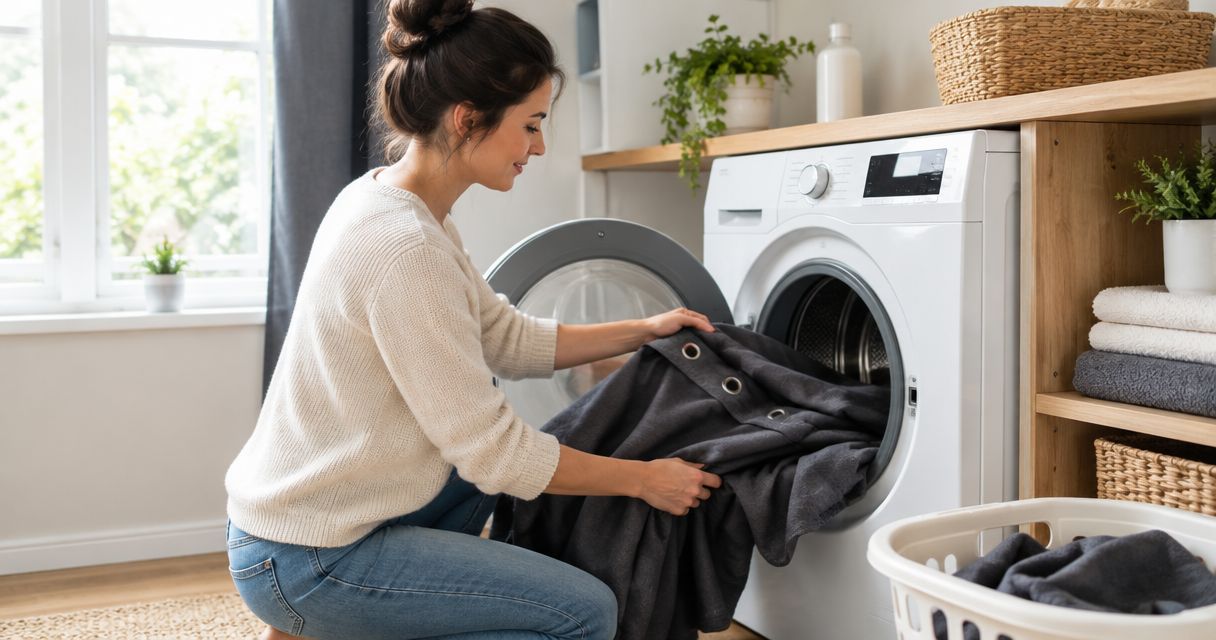
Yes, blackout curtains can be washed at home when the care label permits washing and the fabric, backing, and lining are intact. Curtains marked dry-clean only should not go into your washing machine or a hand-washing basin. This 2026 guide explains how to choose a permitted cleaning method, protect the light-blocking layer, and dry your curtains without guessing.
- Can blackout curtains be washed at home? Yes, but only when their care instructions permit washing.
- Blackout curtain care depends on the fabric, lining, and backing—not just the visible material.
- Stop before washing curtains with peeling backing, damaged seams, or unclear care instructions.
- Curtain-store serves Riyadh homeowners seeking custom curtains and installation support.
Can blackout curtains be washed at home?
The care label decides whether home washing is suitable—not the word blackout. Light-blocking curtains can have different constructions, and the cleaning instructions apply to the finished panel, including its lining, backing, seams, and attached details.
Before taking your curtains down, find the sewn-in label or the care instructions supplied with your order. If you are choosing new bedroom curtains, explore the blackout curtains for bedrooms guide and make cleaning requirements part of your decision.
| Cleaning method | Suitable for | Advantage | Limitation |
|---|---|---|---|
| Machine washing | Curtains explicitly labelled machine washable | Cleans the whole panel at home | Requires the stated cycle and enough room in the drum |
| Hand washing | Curtains whose instructions permit hand washing | Avoids machine agitation | Wet panels are heavy and need careful handling |
| Local stain cleaning | Curtains with instructions allowing local cleaning | Treats a mark without washing the whole panel | Can leave a water mark or affect the finish |
| Professional cleaning | Curtains requiring professional care or with uncertain instructions | Lets a cleaner assess the construction | The cleaner still needs to confirm a suitable method |
A hand-wash instruction is not permission to use a delicate machine cycle. Likewise, a machine-wash instruction does not automatically permit tumble drying, ironing, bleach, or soaking. Check each part of the care instructions separately.
Why this matters
Your blackout curtains do more than finish the room: they help you manage daylight and privacy. Cleaning should preserve that function as well as remove dirt. A curtain that looks clean on the front can still have damage on the reverse.
For your 2026 home-care routine, start with the least intensive cleaning the curtain actually needs and its instructions allow. Surface dust does not automatically justify a full wash, and a small stain does not mean the entire panel needs soaking.
The same principle applies in offices and other business spaces. Arrange cleaning around safe removal and rehanging, particularly where panels are large or connected to motorized hardware.
How do you wash washable blackout curtains at home?
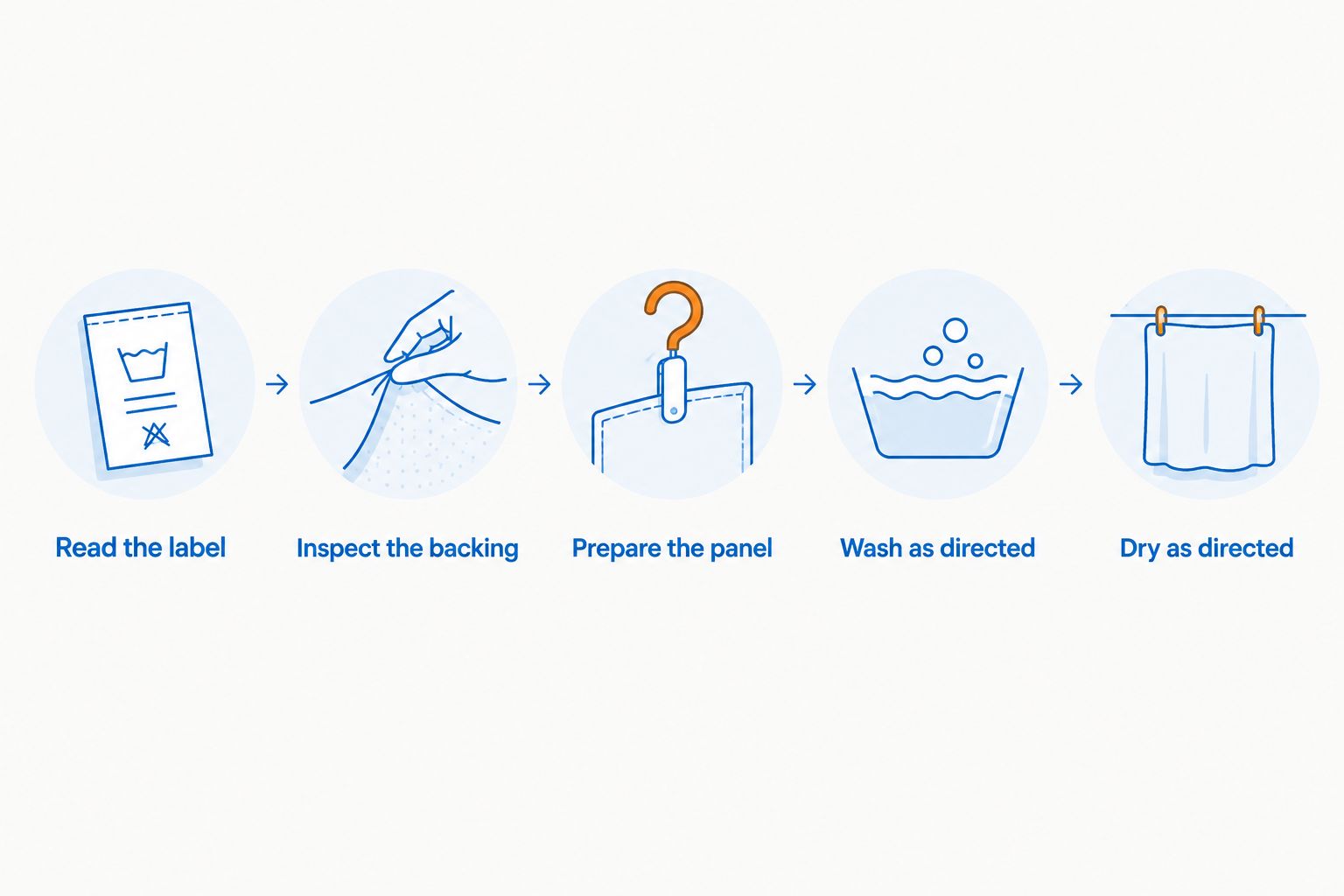
Follow this sequence only after confirming that your curtains permit home washing. If an instruction is unclear, stop before wetting the panel. An inconspicuous test can reveal a problem, but it cannot prove that a whole curtain will tolerate washing.
Read the label
Look for separate instructions covering washing, bleaching, drying, ironing, and professional cleaning. A crossed-out wash-tub symbol means do not wash; a hand inside the wash tub indicates hand washing. Any stated temperature or handling restriction belongs to that curtain, not to every blackout curtain.
Read the written instructions as well as the symbols. If the label is missing, check the order paperwork or ask the seller for the care information for your exact fabric and lining combination. Do not substitute instructions for a similar-looking curtain.
Inspect the backing
Examine the front, reverse, lining, seams, and heading before removal. Look for peeling, flaking, tacky areas, tears, loose stitching, or a lining that has started separating. Existing damage is a reason to seek advice before washing.
Check the whole panel rather than only the bottom corner. Pay particular attention to folds and areas exposed to sunlight. If the backing sheds material when handled, avoid scrubbing or putting it through a wash cycle.
Prepare the panel
Photograph how the curtain hangs and how its removable fittings connect. Remove detachable hooks and accessories as directed, and keep them together so rehanging is straightforward. Do not force out eyelets or other fittings that are part of the curtain.
If the instructions permit surface dust removal, use a gentle method suitable for the fabric and backing. Avoid pulling on the material or dragging an abrasive tool across a coated surface. Dust removal is preparation, not permission to wash.
Wash as directed
Use the method, detergent guidance, and cycle stated in the care instructions. Do not add bleach, stain treatments, or other laundry products unless they are permitted. More cleaning product is not a substitute for the correct method.
For machine washing, confirm that the panel fits without being tightly packed and remains within the appliance manufacturer's load guidance. For hand washing, support the wet fabric and avoid wringing or rubbing a coated backing. If you cannot handle the curtain safely, stop and arrange suitable help.
Dry as directed
Follow the drying instructions rather than assuming every washable curtain can go in a dryer. Support the panel during drying, and avoid folding wet coated surfaces against each other unless the manufacturer permits that handling. Do not use direct heat to speed up the process.
Before rehanging, confirm that the curtain is dry and inspect both sides again. Use an iron or steamer only if the relevant care instruction allows it. Washing permission does not establish heat tolerance.
Machine-washable blackout curtains
Machine-washable blackout curtains are suitable for home washing only within their stated care instructions. The convenience is clear: you can clean the complete panel without manually handling it throughout the wash. The limitation is that a large panel still needs an appropriate machine and careful drying.
Do not assume a delicate cycle is suitable simply because it sounds gentle. Use the cycle specified for the curtain, and consult the appliance instructions when selecting the corresponding setting. Wash curtains separately from items with exposed fasteners that can catch the fabric.
If the curtain cannot move freely in the drum, do not force it in. Choose a suitable alternative with professional advice rather than changing the curtain's permitted cleaning method yourself.
Hand-washable blackout curtains
Hand-washable blackout curtains can be cleaned at home when you have a suitable space to wash, rinse, and support them. The advantage is avoiding machine agitation. The drawback is handling a large, water-heavy panel without twisting it or straining its seams.
Follow the stated instructions for detergent, water, and handling. Do not turn hand washing into an extended soak unless soaking is specifically permitted. Keep a coated reverse away from rough basin edges and abrasive brushes.
Plan the drying arrangement before you start. If lifting or supporting the wet panel is difficult, professional handling is a more practical choice than trying to manage it alone.
Dry-clean-only blackout curtains
Dry-clean-only blackout curtains should not be washed at home. Hand washing is still washing, and a gentle machine setting does not override the label. The benefit of professional care is having the cleaning method assessed; the limitation is needing an appointment and safe transport or removal arrangements.
Tell the cleaner that the curtains are blackout curtains and show the care label. Mention any backing damage, previous stain treatment, or attached details. A professional cleaner must still decide whether the curtain's condition allows cleaning.
For dust between cleaning appointments, follow the curtain's permitted maintenance instructions. Do not assume water-based spot cleaning is acceptable on a dry-clean-only panel.
Why blackout curtain washing instructions vary
Blackout describes what a curtain does, not one universal fabric recipe. These construction differences explain why a washing method suitable for one panel can be unsuitable for another:
- Face fabric: The visible material has its own washing, shrinkage, and heat-care requirements.
- Blackout backing: A coating or bonded layer needs care appropriate to that finish.
- Separate lining: The lining and outer fabric must tolerate the same cleaning method when washed together.
- Attached details: Trims, headings, and fixed fittings can restrict how the completed curtain is cleaned.
- Current condition: Damaged seams or deteriorating backing change whether routine cleaning is sensible.
You cannot settle these questions by touch alone. A soft curtain is not automatically hand washable, and a thick curtain is not automatically dry-clean only. Use the instructions for the complete curtain, not assumptions about its appearance.
What should you check before washing curtains in 2026?
Set up the washing and drying space before removing anything from the track. You need a permitted cleaning method, manageable handling, and somewhere suitable for the panel to dry. Finding a drying problem after washing is avoidable.
Use this short preparation checklist:
- Locate the care label and retain a photograph of it.
- Check both curtain faces and the lining for damage.
- Confirm how detachable fittings should be removed.
- Check that your washing equipment suits the panel.
- Prepare the permitted drying arrangement.
- Arrange help where removal or lifting is unsafe alone.
Keep panels from different windows identified. Curtains that appear identical can differ in length, lining, or care instructions, especially when ordered at different times. Check each label instead of treating the whole room as a single laundry load.
What if your blackout curtains have no care label?
Do not wash unlabelled blackout curtains by guesswork. Ask the seller or maker for instructions matching the actual fabric, lining, and backing. A photograph of the front and reverse can help explain what you have, but appearance alone does not establish washability.
For a custom curtain order in 2026, request care information before approving the fabric and lining. Ask whether the finished panel permits machine washing, hand washing, local cleaning, or professional cleaning, and how it should be dried.
Curtain-store offers ready-made and custom curtains, fabrics, and installation services in Riyadh. If you are planning a new order, call to discuss your room and ask about care instructions for the proposed curtains; use WhatsApp as a secondary contact option. Easy cleaning is a useful selection criterion, but custom construction does not itself mean machine washable.
Can you wash blackout curtains with a coated backing?
Coated blackout curtains can be washed at home only when the completed curtain's instructions permit it. Check for peeling, flaking, or sticky areas before cleaning, and do not scrub the coating. Stop if you find deterioration rather than trying to wash it away.
Can you tumble-dry blackout curtains after washing?
Blackout curtains can be tumble-dried only when their drying instructions allow it. A washable label is not permission to use a dryer. Follow the specified drying method and check ironing or steaming instructions separately.
Is spot cleaning safer than washing the whole curtain?
Spot cleaning is suitable only when the curtain's care instructions permit it. It reduces the area you wet, but local treatment can still affect colour, backing, or appearance. Use the permitted method and stop if the test area changes.
FAQ
Can blackout curtains be washed at home in a washing machine?
Yes, blackout curtains can be machine washed when their care label explicitly permits machine washing. Follow the stated cycle and drying instructions, and do not pack a large panel tightly into the drum.
Can I hand wash blackout curtains marked dry-clean only?
No, do not hand wash blackout curtains marked dry-clean only. Hand washing still exposes the fabric, lining, and backing to water and does not override the care label.
What temperature should I use to wash blackout curtains?
Use the washing temperature stated on your blackout curtain's care label. There is no single temperature suitable for every blackout fabric, coating, and lining combination.
Can I use bleach on blackout curtains?
Use bleach only if the blackout curtain's care instructions explicitly permit it. A machine-washable instruction does not automatically allow bleach or other stain treatments.
Should I wash blackout curtains if the backing is peeling?
Do not wash blackout curtains with peeling backing before obtaining suitable care advice. Washing will not restore a deteriorating light-blocking layer, and the panel needs assessment before further treatment.
Can I iron blackout curtains after washing them?
Iron blackout curtains only when their ironing instructions permit it. Check restrictions for the fabric and backing, and do not assume steaming is an acceptable alternative.
What should I ask when ordering custom curtains in Riyadh?
Ask for cleaning and drying instructions for the finished curtain, including its lining and backing. For a Curtain-store custom curtain order, discuss your preferred maintenance method alongside your privacy and room requirements.
One last thing
The easiest cleaning decision happens before you buy the curtain. If home washing matters to you, make it a requirement when selecting the finished fabric-and-lining combination, not a question you leave until the first stain.
Keep a photograph of the care label with your curtain order details for 2026. That small record helps you find the right instructions after the label becomes difficult to reach or the original paperwork is put away.