
Yes—heat-insulating curtains can reduce AC electricity use in Riyadh by limiting heat entering through sunlit windows, but they do not guarantee a particular reduction in your bill. For your 2026 purchase, choose curtains by their lining, window coverage and installation—not just the word thermal—and remember that walls, roofs, air leaks and AC settings also affect cooling demand.
- Do heat insulating curtains actually reduce AC bills in Riyadh? Yes, but window heat reduction is not whole-home electricity savings.
- Curtain-store offers custom curtains and installation for Riyadh homeowners seeking fitted window treatments.
- Blackout curtains control light; thermal performance also depends on lining, coverage and how you use them.
- Close curtains before direct sunlight reaches the glass, and compare electricity use under similar weather and AC settings.
Do heat-insulating curtains actually reduce AC bills in Riyadh?
Heat-insulating curtains help when sunlight through the windows contributes to your room's cooling load. They shade the room and, depending on construction and fit, reduce heat exchange around the window. Your AC then has less window-related heat to remove while maintaining the same temperature setting.
The distinction matters: reducing heat at a window is not the same as reducing your entire electricity bill by that percentage. Your bill includes other appliances, and your home's cooling load includes more than its windows. A darker room alone does not prove an energy saving.
For your 2026 decision, the US Department of Energy's Energy Saver guidance provides useful context: medium-coloured draperies with white plastic backings can reduce heat gains by 33%. That figure concerns heat gain under the described conditions—not a promised reduction in AC consumption, and not a result measured in Riyadh homes.
Use that evidence to ask better questions about construction rather than expecting the same result from every curtain. A decorative panel, a blackout panel and a lined thermal curtain are not interchangeable simply because they look substantial.
Explore heat-insulating curtains for Riyadh homes with attention to the window-facing layer and the finished fit. Fabric colour alone is not enough to make the decision.
Why this matters
You want a comfortable room, not just a darker window. Curtains can improve privacy and reduce glare while addressing one source of incoming heat, which makes them useful even when you cannot isolate their effect on your electricity bill.
Start with the room where direct sun interrupts everyday life: a bedroom that heats up before bedtime, a living room with glare across the seating area, or an office with sunlight across desks. Prioritising a specific problem makes the choice clearer than replacing every curtain at once.
For business spaces, keep the same focus on comfort while accounting for working hours, daylight needs and access to windows. A treatment that stays open throughout the sunniest period cannot deliver its intended shading benefit.
Thermal curtains, blackout curtains or sheers?
These terms describe different priorities. Thermal curtains address heat transfer, blackout curtains address light blocking, and sheers soften daylight while keeping a lighter appearance. Some curtains combine thermal and blackout functions, but one label does not establish the other.
| Window treatment | Best suited to | Main benefit | Limitation to consider |
|---|---|---|---|
| Lined thermal curtains | Sun-exposed rooms where heat control matters | Shading and an additional layer at the window | Performance depends on construction, coverage and use |
| Blackout curtains | Bedrooms and rooms needing stronger light control | Reducing incoming light and glare | Blackout wording alone does not establish thermal performance |
| Sheer curtains | Rooms where filtered daylight is the priority | Softening sunlight without fully closing off the view | Not a substitute for a heat-control layer |
| Sheers with lined curtains | Rooms needing different daytime and evening settings | Separate control over filtered light and fuller coverage | Requires suitable mounting space and more fabric to manage |
Choose the function first, then the appearance. If you need both afternoon heat control and a bright room at other times, a layered arrangement gives you separate choices rather than forcing one curtain to do everything.
Ask to see the lining as well as the front fabric. The side facing the window is part of the heat-control decision, even though it is not the side you look at from the sofa.
Why the effect on AC bills varies
The benefit changes with the window, the room and your routine. These factors explain why a single savings promise is not a useful basis for choosing curtains:
- Sun exposure: Curtains have a different job at a window receiving direct sunlight than at a shaded window.
- Window construction: Glass type, frames and existing shading affect how much heat reaches the room.
- Curtain construction: Lining, backing and the complete fabric assembly matter more than a decorative description.
- Coverage and gaps: Exposed glass and openings around the edges weaken the intended barrier.
- Closing time: Closing curtains after the room has heated up misses part of the opportunity to prevent incoming heat.
- The rest of the home: Roofs, walls, air leakage, appliances and AC operation also contribute to electricity demand.
Do not judge performance by touch alone. A curtain feeling warm beside the glass does not tell you how much electricity your AC has used, and a cooler-feeling room does not establish a household bill reduction.
How to choose curtains for a sun-exposed room
Start with the window that causes the problem
Identify when direct sunlight reaches the glass and where it falls inside the room. Look at your normal seating or sleeping position, not only the window itself. Glare across a sofa and sunlight warming a bedroom are different problems, even when the windows look similar.
Describe the discomfort plainly when discussing the order: afternoon glare, unwanted light during sleep, or heat near a large window. This gives the selection process a practical purpose. Colour and texture can follow without becoming the only criteria.
Check the complete curtain, not just the fabric name
Ask whether the proposed curtain includes a lining and what evidence supports any thermal claim. If performance information is available, check whether it applies to the finished curtain assembly or only to a fabric sample. Do not assume that a heavier-looking material has documented insulation performance.
Treat blackout and thermal descriptions separately. You can want both, but the seller should explain how the proposed construction serves each purpose. A clear description of the layers is more useful than an unexplained energy-saving label.
Make coverage part of the order
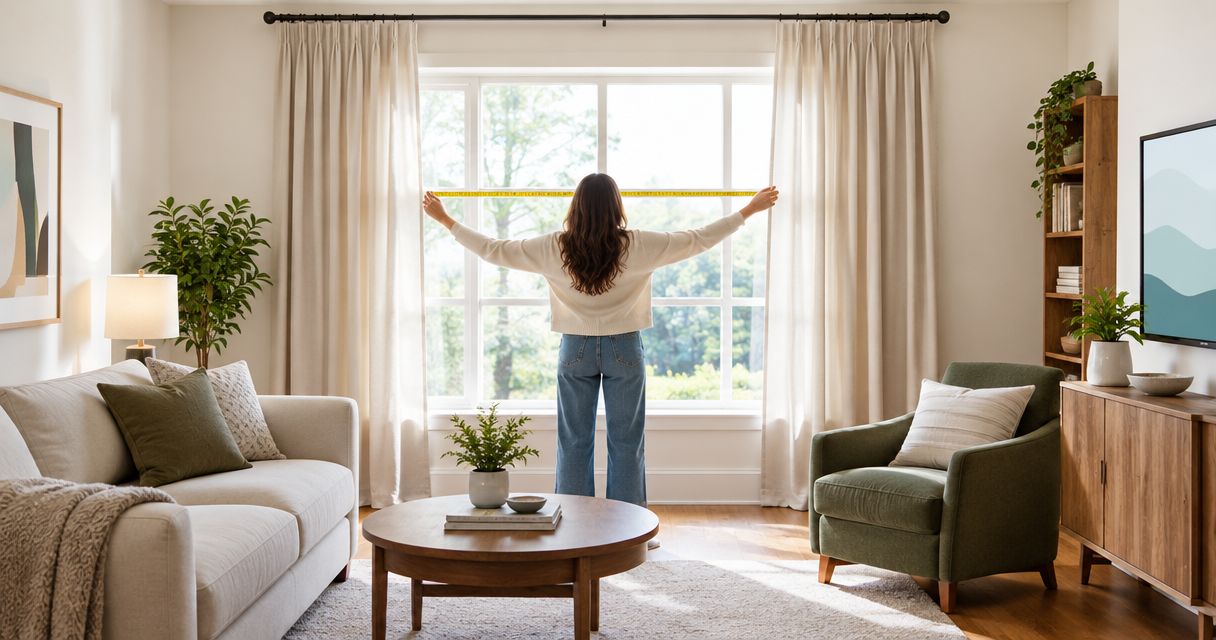
Discuss the finished width, drop and mounting position before confirming the fabric. The curtain should cover the intended window area when closed, rather than leaving strips of exposed glass because the panels were chosen mainly for appearance.
Check the practical obstacles too: handles, furniture, opening windows and AC outlets. Keep airflow unobstructed. A curtain should help manage the window without interfering with the cooling system or making the room awkward to use.
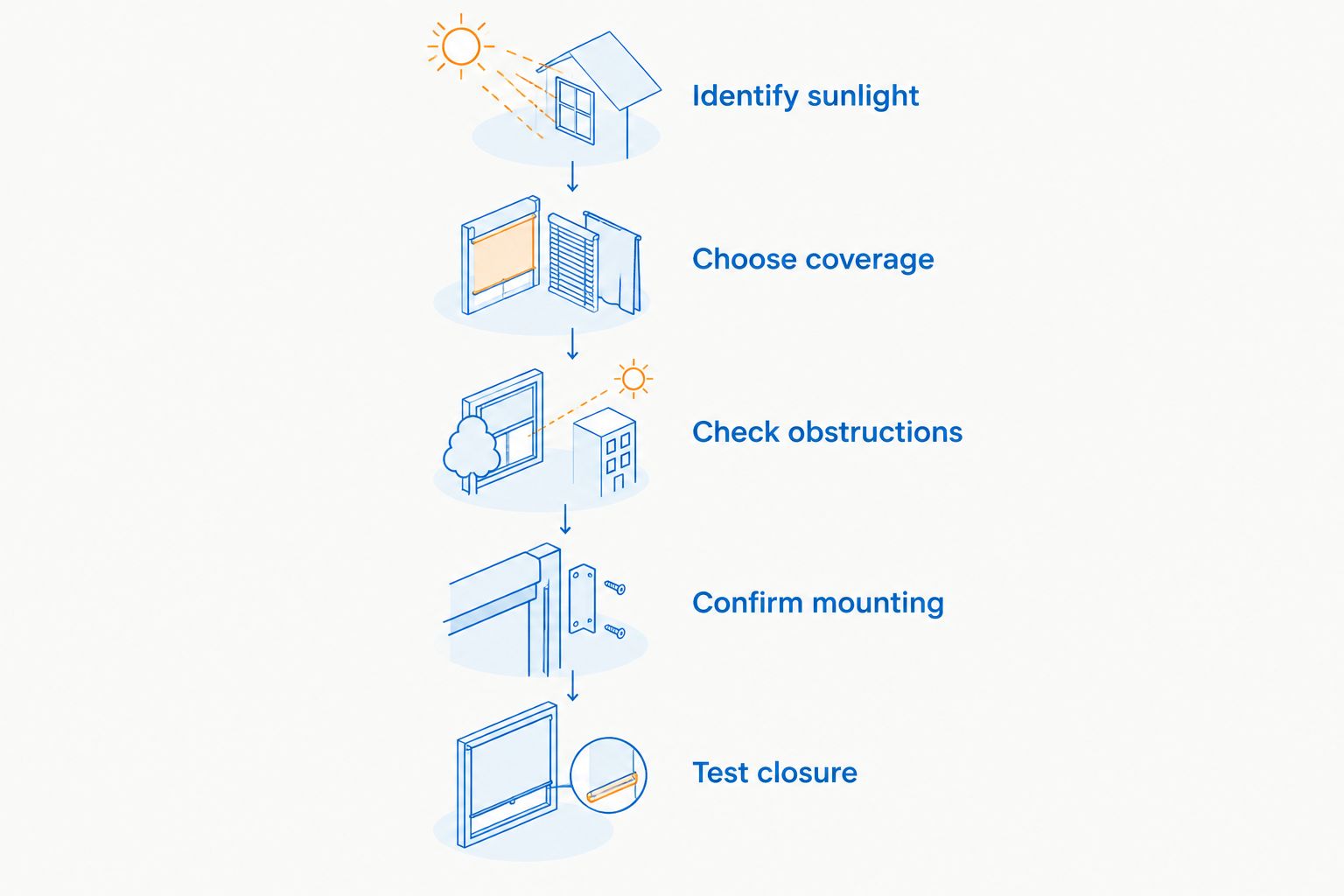
A simple measurement and installation checklist
A careful fit connects your fabric choice to everyday performance. For a 2026 custom order, agree on the finished arrangement before installation rather than leaving the mounting position to a last-minute decision.
- Identify sunlight. Note which window receives direct sun and when you normally occupy the room.
- Choose coverage. Decide whether the treatment covers the window opening or extends across a wider wall area.
- Check obstructions. Identify handles, nearby furniture and AC outlets that affect movement or mounting.
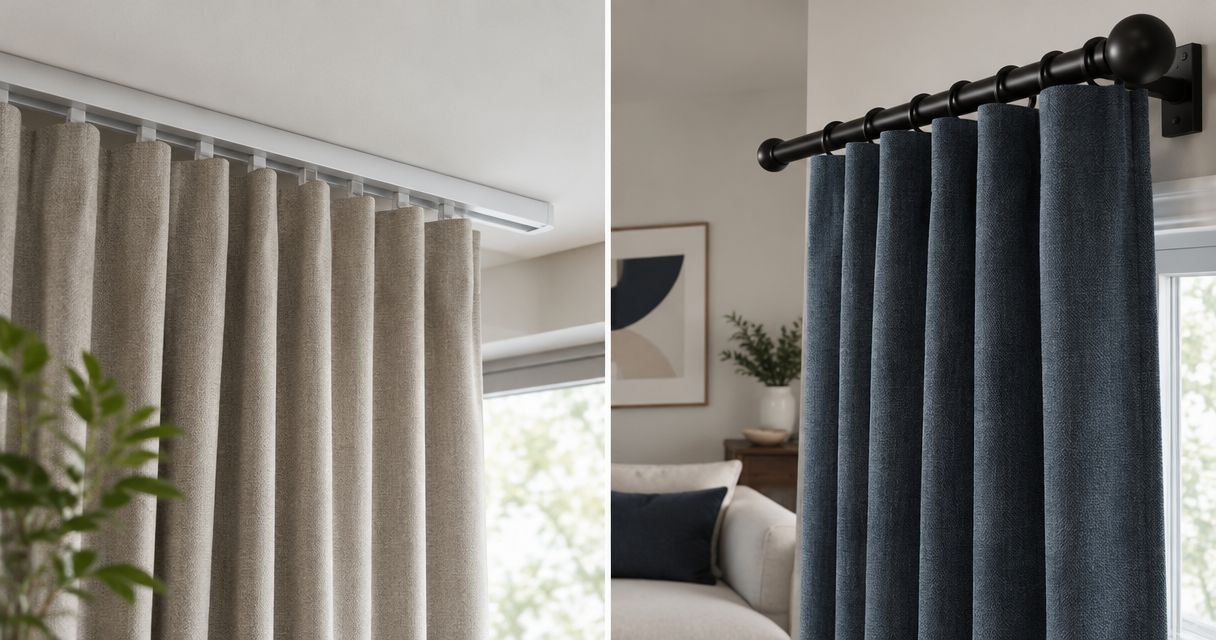
- Confirm mounting. Agree on the rod or track position and how the panels meet when closed.
- Test closure. After fitting, close the curtains fully and check for exposed glass, awkward movement and gaps you did not intend.
Do not use glass dimensions alone as the finished curtain dimensions. The mounting arrangement and desired coverage determine the final order. If you are unsure, discuss the measurement requirements before buying fabric or selecting ready-made panels.
Once installed, operate the curtains from the position you will actually use every day. Panels that are difficult to reach or move are easier to leave open. Ease of operation belongs in the selection discussion, especially behind furniture or across large windows.
Close the curtains before the room heats up
Use the sun's arrival as your cue—not the moment the room becomes uncomfortable. Closing the curtains before direct sunlight reaches the window helps prevent some incoming heat instead of waiting for the AC to remove it afterward.
Keep the routine specific to each room. An east-facing window and a west-facing window do not receive direct sun at the same time, so a single closing schedule is not automatically appropriate for the whole home. Observe the actual sunlight at your windows.
If you use sheers with a lined curtain, draw the lined layer when you need fuller shading. The sheer can remain useful when filtered daylight is the priority. You do not need to keep every room dark throughout the day to use curtains deliberately.

Give everyone using the room the same simple instruction: close the heat-control layer before the direct sun arrives. In offices and shared spaces, an agreed routine prevents the treatment from being selected for heat control but used only for decoration.
How to check whether your electricity use changes
For a practical home comparison in 2026, record electricity use for 7 days before changing the curtain routine, then for 7 days with the curtains closed during direct sun. This is a suggested observation method, not a certified performance test or a guarantee that two weeks will produce a clear result.
Keep the AC temperature setting, operating hours and room use as similar as possible. Record whether the weather was comparable, because hotter conditions can increase cooling demand even when the curtains are helping. Note unusual events such as visitors, travel or appliances running for longer than normal.
| What to record | Why it matters |
|---|---|
| Electricity consumption in kWh | Separates energy use from changes in the billed amount |
| AC temperature setting and hours | Shows whether the cooling routine changed |
| Outdoor conditions | Helps identify weather-related differences |
| Curtain opening and closing times | Confirms whether the shading routine was followed |
| Occupancy and unusual appliance use | Flags other reasons for higher or lower consumption |
Compare consumption, not just the total amount charged. If your meter covers the entire home, the result also includes cooking, lighting and other appliances. That limits how confidently you can attribute a change to curtains alone.
Record comfort separately: less glare, a more comfortable seat beside the window, or better control over bedroom light. These are useful outcomes, but comfort observations and measured electricity savings are different kinds of evidence.
Are blackout curtains enough for Riyadh summer heat?
Blackout curtains address light blocking; their heat-control performance depends on their construction and fit. For your 2026 order, ask about the lining and window-facing surface instead of assuming the blackout label answers both questions.
If your main problem is bedroom light, blackout performance deserves priority. If heat beside a sun-exposed window is the concern, include thermal construction and coverage in the discussion. The right order can address both needs without treating them as identical.
Will thicker curtains always save more electricity?
Thickness alone does not establish an electricity saving. The fabric assembly, backing, mounting and time spent closed all affect the result, while your home's other heat sources remain part of the cooling load.
Choose a curtain you can operate comfortably and fit properly. A substantial panel left open during direct sunlight does not provide the shading you bought it for.
Can curtains replace AC maintenance or window repairs?
No—curtains do not repair an inefficient AC system or seal damaged window frames. They address part of the window-related heat problem, not every reason a room stays hot.
If the room remains uncomfortable with the curtains closed, check for air leakage and arrange appropriate AC maintenance. Do not keep changing fabrics when the underlying issue is elsewhere.
Choosing a curtain service in Riyadh
Curtain-store is suited to Riyadh homeowners who want custom curtains with installation support. It offers ready-made and custom curtains, blinds, fabrics and installation services for homeowners and businesses. For your 2026 enquiry, describe the room, sunlight and privacy needs before discussing finishes.
Explore Curtain-store and call using the contact details currently listed there; use WhatsApp as a secondary option where listed. Ask what measurement support is included and how the proposed installation handles coverage around your window. Custom fitting helps address dimensions, but it does not establish a particular electricity saving.
FAQ
Do heat-insulating curtains actually reduce AC bills in Riyadh?
Heat-insulating curtains can reduce AC electricity use by limiting heat entering through sunlit windows. The effect on your bill depends on the curtain construction, fit, closing routine and the rest of your home's cooling demand.
What percentage can thermal curtains save on my electricity bill?
No single percentage applies to every household. The US Department of Energy's 33% figure concerns heat-gain reduction for medium-coloured draperies with white plastic backings, not a 33% reduction in your electricity bill.
Are blackout curtains the same as thermal curtains?
Blackout curtains and thermal curtains describe different functions: light blocking and heat control. A curtain can serve both purposes, but the lining and complete construction need to support that choice.
When should I close curtains to keep a room cooler?
Close the heat-control curtains before direct sunlight reaches the window. Waiting until the room feels hot leaves the AC to remove heat that has already entered.
Do I need to replace curtains in every room?
Start with the sun-exposed room where heat or glare causes the clearest problem. Observe its comfort and use before deciding whether other rooms need a similar treatment.
How do I compare electricity use before and after fitting curtains?
Compare meter consumption in kWh while keeping weather, AC settings, occupancy and operating hours as similar as possible. Whole-home readings include other appliances, so they do not isolate curtain performance.
Does Curtain-store offer custom curtains and installation in Riyadh?
Curtain-store offers custom curtains and installation services in Riyadh. Call using its currently listed contact details to discuss your window, measurement requirements and proposed fitting arrangement.
One last thing
Before replacing a curtain, try changing when you close it. A suitable lined curtain already in your home might be doing less than intended simply because it stays open while direct sunlight enters. Check its coverage, then use it earlier in the sun cycle.
For a new purchase, bring photos showing the window both open and covered, plus a note about when sunlight reaches the room. That gives your curtain discussion a useful starting point: the comfort you want and the window conditions the treatment must address.