
No—sheer curtains do not provide reliable privacy at night with the lights on. When your room is brighter than the space outside, people looking in can see through the fabric, including movement, silhouettes, and sometimes room details. Keep sheers for softened daylight, and close an opaque curtain or suitable privacy blind after dark.
- Do sheer curtains provide privacy at night with lights on? No—sheers alone are not a dependable privacy barrier.
- Pair sheer curtains with an opaque layer for daylight filtering and nighttime privacy.
- Test fabric with indoor lights on; weave, lighting, and coverage determine visibility.
- Curtain-store offers custom curtains and installation for Riyadh homeowners planning layered window treatments.
Why this matters
A window can feel private during the afternoon and expose your room after sunset. The curtain has not changed; the lighting around it has. That difference matters in bedrooms, family living rooms, and majlis spaces where you want to enjoy the evening without checking who can see inside.
For a 2026 window update, decide how you want the room to work after dark before choosing its daytime appearance. Curtain-store offers ready-made and custom curtains, blinds, fabrics, and installation services in Riyadh. Start with the privacy you need, then choose the fabric and finish that make the space feel comfortable.
Do sheer curtains provide privacy at night with lights on?
Sheer curtains soften the view; they do not reliably block it when indoor lights are on at night. Their open or translucent construction lets light pass through. It also lets an observer see information about the brighter space behind the fabric.
How much someone sees depends on the fabric and the viewing conditions. A fine sheer can reveal more detail than a denser translucent fabric, but neither should be treated as an opaque barrier without checking it in your actual room.
Use this comparison to separate daylight filtering from nighttime privacy:
| Window treatment | Best suited to | Main benefit | Main limitation |
|---|---|---|---|
| Sheer curtains alone | Softening daylight | Keep a light, open appearance | Do not provide dependable privacy with indoor lights on |
| Sheers with opaque curtains | Rooms used during the day and evening | Let you switch between filtered light and privacy | Require space and hardware for separate layers |
| Sheers with an opaque roller blind | Windows where you want different daytime and evening settings | Keep the sheer look while adding a separate privacy layer | Blind edges and fabric opacity need checking |
| Opaque curtains alone | Rooms where privacy takes priority | Block the direct view through covered areas | Reduce daylight when closed |
| Blackout curtains | Bedrooms needing privacy and darkness | Combine an opaque fabric with light blocking | Gaps around the curtain can still admit light and expose sightlines |
The key distinction is between filtering light and blocking a view. A curtain that creates a pleasant glow is doing its light-filtering job, even if it does not protect nighttime privacy. Choose each layer for its job rather than expecting one sheer panel to do both.
Sheer curtains alone: for daylight, not nighttime privacy
Sheers suit a room where you want softer daylight and a less exposed feeling without closing an opaque curtain. They can soften the view into a room when the exterior is brighter, but daytime privacy still depends on the weave, proximity, and viewing angle.
That benefit has a limit. Once the room becomes the brighter side of the window, the same translucent material lets indoor light and visible shapes pass outward. A comfortable daytime setup is not proof of a private evening setup.
For a 2026 fabric selection, assess a sheer as a daylight layer. Look at its texture, how it hangs, and how it changes the light in the room. Do not choose sheer curtains alone for a bedroom or changing area that needs privacy after dark.
Sheers with opaque curtains: separate jobs for separate layers
Layering gives you a straightforward routine: use the sheer when you want filtered daylight, then close the opaque curtain when you need privacy. You keep the appearance you enjoy without asking translucent fabric to block the evening view.
The trade-off is the installation. Both layers need room to move, and the outer curtain must close fully without catching on the sheer. Furniture, handles, and the position of the track or rod can affect how neatly the layers work.
You do not need to replace a sheer you already like just because it fails the nighttime test. An added opaque layer can address that specific problem. Check the existing hardware and available space before deciding how to fit it.
Sheers with an opaque blind: check the fabric and edges
A sheer curtain paired with an opaque blind separates the decorative layer from the privacy layer. You can leave the sheer drawn and lower the blind for the evening. This arrangement suits windows where you prefer not to add another curtain panel.
The word blind does not establish privacy by itself. A translucent roller fabric still transmits light, while an opaque fabric blocks the direct view through the material. Slatted blinds also depend on their closed position and the angle from which someone looks.
Inspect the edges as carefully as the centre. A blind that covers the glass but leaves an exposed side sightline needs a different fitting decision. Choose the fabric and installation together, not as separate purchases.
Why nighttime privacy varies
These factors explain why two windows with similar-looking sheers can behave differently:
- Light balance: A brightly lit room against a dark exterior makes the interior easier to see through translucent fabric.
- Fabric construction: Open weaves and thinner translucent materials allow more visual information through than opaque materials.
- Lamp position: A light behind a person can make that person's silhouette more visible through the curtain.
- Viewing position: Someone close to the window or looking from a particular angle can have a different view from someone farther away.
- Coverage: Open sides, an unfinished centre overlap, or exposed glass leave sightlines even when the curtain fabric is opaque.
- Layer position: An opaque curtain or blind only protects the areas it actually covers when closed.
Colour is not a substitute for checking these factors. A dark sheer is still a sheer if its construction allows light through. A pale opaque curtain can block a view even though its colour looks lighter.
How do you check whether people can see through your curtains?
Test your curtains in the conditions that concern you: after dark, with the room lit as you normally use it. Looking toward the window from inside is not enough. You need to check the view from the other side.
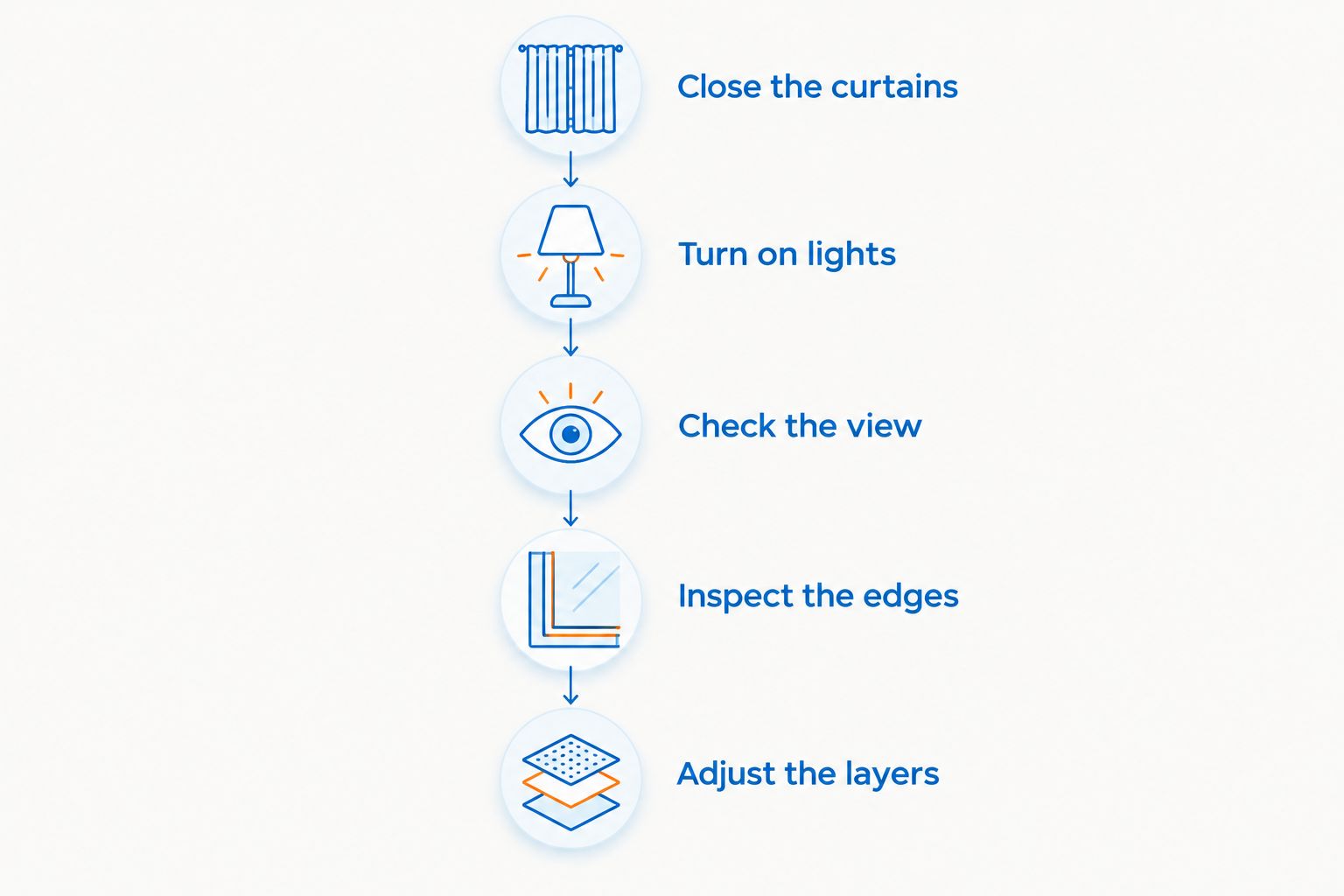
Use this sequence when reviewing samples or existing curtains in 2026:
- Close the curtains. Arrange them as you would during an ordinary evening, including the centre join and sides.
- Turn on lights. Use your usual ceiling lights and lamps rather than creating an unusually dim test room.
- Check the view. Ask someone you trust to look from an accessible, appropriate outside position while you remain indoors.
- Inspect the edges. Check exposed glass, side gaps, and the centre opening separately from the fabric itself.
- Adjust the layers. Close an opaque layer and repeat the check to confirm that the direct view is blocked.
An outside check must respect neighbours' property and personal safety. For an upstairs window or inaccessible exterior, compare the fabric against a lit background and discuss the sightlines during installation planning. Do not climb or enter another property to test a curtain.
A small fabric sample helps you compare transparency, but it does not show how a full curtain will close. Treat the sample check and the fitted-window check as separate decisions. One assesses the material; the other assesses the complete covering.
What should you measure before adding a privacy layer?
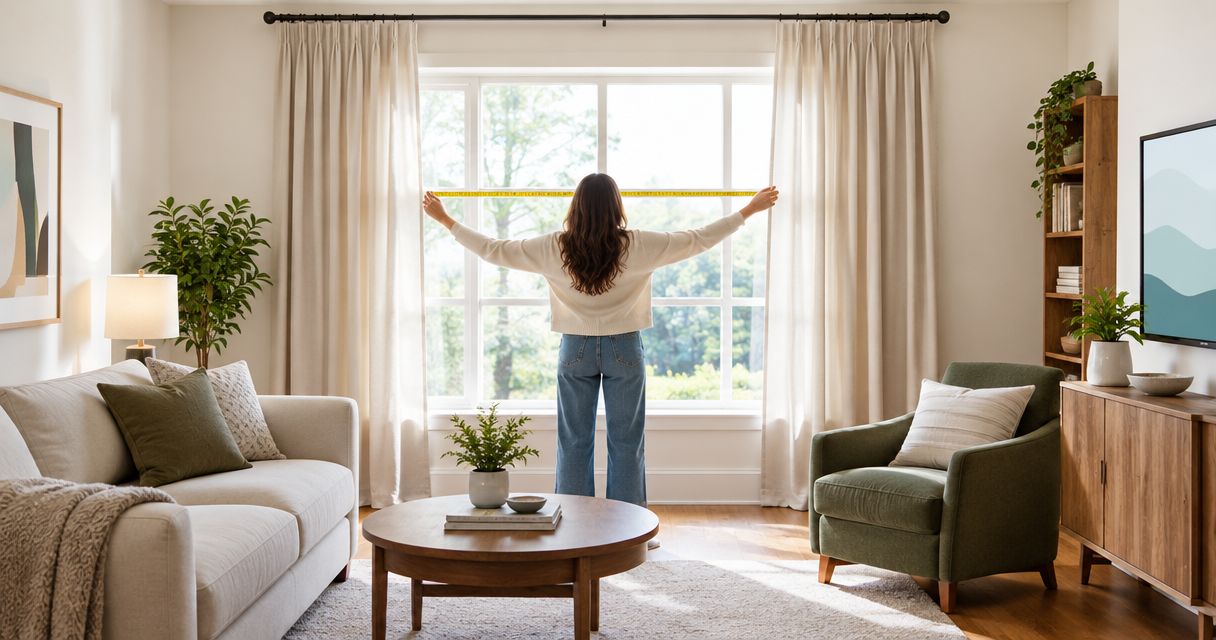
Measure the area the curtain must cover, not just the visible glass. The final position of the hardware determines where the curtain starts, how it closes, and whether it can cover the sides. Record obstructions such as handles, nearby walls, and furniture as well.
The window measurement guide explains the measurement task in more detail. For layered curtains, tell the installer that nighttime privacy is a requirement rather than leaving it as an assumption.
For your 2026 order, discuss these points before approving the arrangement:
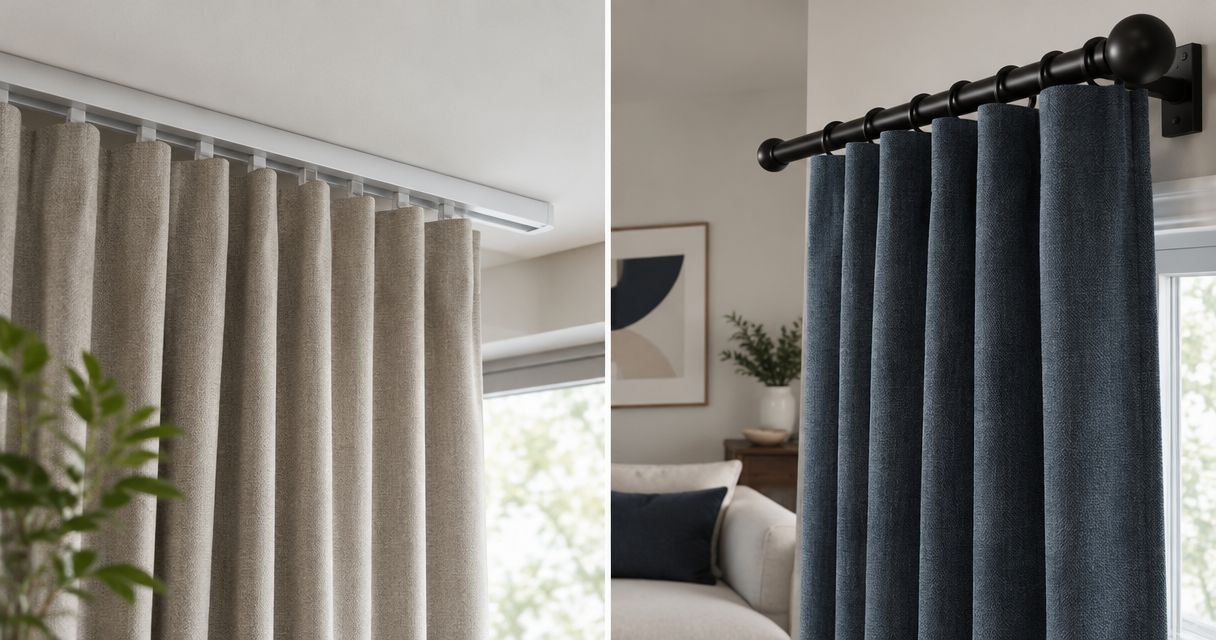
- Whether the existing rod or track can support separate layers.
- Whether both layers can open and close without catching.
- How the opaque layer will meet at the centre.
- How the sides will cover the window from relevant viewing angles.
- Whether the curtain clears handles and nearby furniture.
- How you will reach and operate each layer comfortably.
A custom size helps address a specific window layout, but the word custom does not establish fabric opacity. Specify both the covering arrangement and the privacy requirement.
Can people see silhouettes through sheer curtains at night?
Yes—silhouettes can remain visible through sheer curtains when the room is lit. Even if facial details are unclear, movement and body outlines can be enough to compromise the privacy you want.
Do not judge a curtain only by whether someone can identify an object clearly. For a bedroom, dressing area, or treatment room, concealing movement matters too. Use an opaque layer rather than accepting a blurred view as private.
Do thicker sheer curtains solve the problem?
Thicker sheers can obscure more detail, but thickness alone does not establish nighttime privacy. Translucency is the important distinction: if light and shapes remain visible through the material, the fabric is not performing as an opaque barrier.
Extra folds can change how a sheer looks, but they do not guarantee that every part of the window is covered by overlapping fabric. Check the least-covered area rather than only the densest fold.
Do you need blackout curtains for privacy?
No—nighttime privacy requires an opaque covering, not necessarily a blackout treatment. Blackout curtains are relevant when you also want to reduce incoming light, such as in a bedroom.
Privacy and darkness are related but different goals. An opaque curtain can block the direct view through its fabric while light still enters around its edges. Choose the construction and fitting according to both needs, without assuming one label settles everything.
Choosing a comfortable setup for your Riyadh room
For a living room or majlis, decide whether you want daylight filtering, evening privacy, or both. If you enjoy the sheer appearance, keep it as one layer and add an opaque covering that you can close when needed. For bedrooms, assess privacy alongside your preference for darkness.
Business spaces need the same distinction. A sheer that softens daylight in a reception area should not be treated as a privacy screen for a changing or consultation area. Assess each room by what happens inside it, not just by the appearance of neighbouring windows.
Curtain-store suits Riyadh homeowners seeking custom curtains and installation support for layered window treatments. Call to discuss the room, your existing sheers, and the privacy layer you need; use WhatsApp as a secondary contact route. Confirm the measurement and installation arrangements before placing an order.
FAQ
Can people see through sheer curtains at night when my lights are on?
Yes—people outside can see through sheer curtains when the interior is brighter than the exterior. The visible detail depends on the fabric, lighting, and viewing position, so use an opaque layer for reliable nighttime privacy.
Do sheer curtains give me privacy during the day?
Sheer curtains can obscure the daytime view when the outside is brighter than the room, but they do not guarantee privacy. Check the fabric from relevant outside viewing positions rather than assuming that every sheer works the same way.
Will dark sheer curtains stop people seeing inside?
Dark sheer curtains are not a dependable nighttime privacy barrier simply because they are dark. Fabric construction and translucency matter more than colour alone.
Can I keep my sheer curtains and add privacy?
Yes—keep your sheers and add an opaque curtain or suitable opaque blind. Check that the hardware, coverage, and operating space suit the additional layer.
Are blackout curtains necessary for nighttime privacy?
No—an opaque covering can provide nighttime privacy without being a blackout treatment. Blackout curtains are useful when blocking incoming light is also a goal, but edge coverage still needs checking.
Will turning off one lamp make sheer curtains private?
Turning off one lamp does not establish privacy through sheer curtains. Assess the whole room under its normal evening lighting, then close an opaque layer if the interior remains visible.
What should I ask about before ordering custom curtains?
Ask about fabric opacity, separate-layer hardware, centre closure, side coverage, and installation arrangements. Explain that you need privacy with the room lights on, not only a softer daytime view.
One last thing
The gap beside an opaque curtain can defeat the privacy you expected from the fabric. Before signing off on your 2026 window treatment, close it as you would at night and check the complete window, not just the centre panel.
When you speak with Curtain-store about custom curtains, describe the evening use of the room first. A simple brief—filtered daylight when open, privacy with the lights on when closed—keeps the fabric choice and installation focused on your comfort.