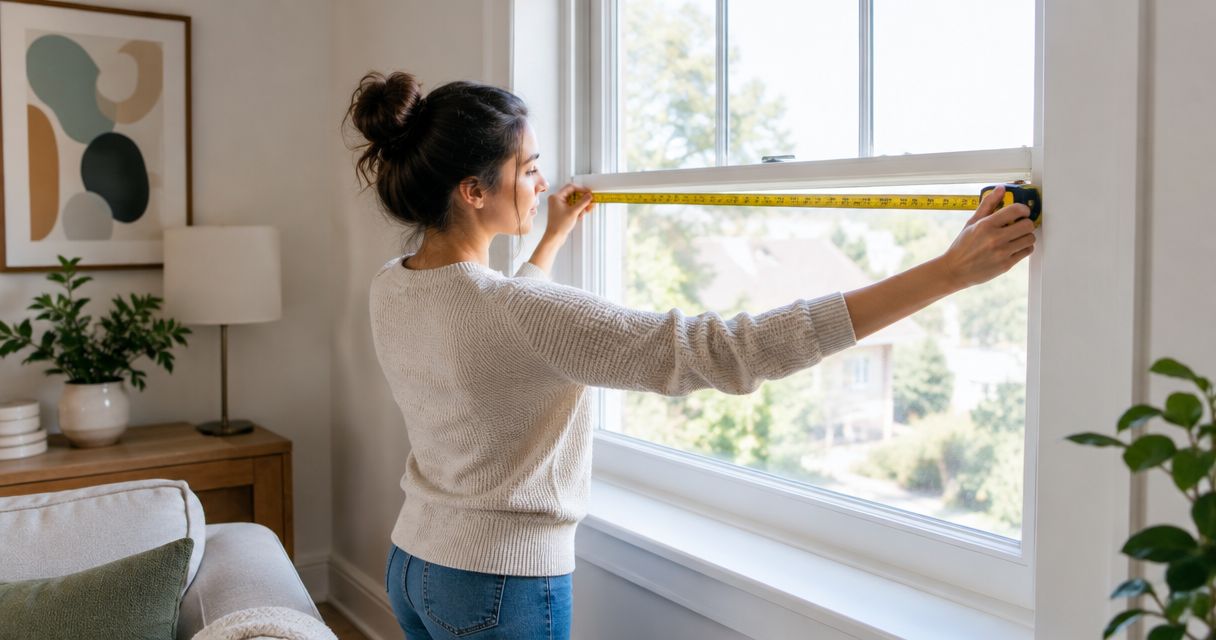
Measure the usable width of your curtain rod or track, then measure the drop from the fixing point required by your chosen curtain heading to the place where the fabric should finish. If the hardware is not installed, mark its intended position first; measuring only the glass will not give you the finished curtain size.
- How do I measure my windows for custom curtains? Measure the track width and the heading-specific drop.
- Curtain-Store suits Riyadh homeowners seeking custom curtains and installation services.
- Keep window dimensions, hardware dimensions, and finished curtain dimensions separate.
- Confirm the curtain heading before measuring the drop; different headings use different starting points.
How do I measure my windows for custom curtains?
Measure the hardware width and the finished curtain drop, not just the window opening. For your 2026 curtain order, record the dimensions of each window separately and label exactly what you measured.
If you prefer help with a custom order, Curtain-Store offers custom curtains and installation services for Riyadh homeowners and businesses. Call to discuss your window layout and confirm the measurement and installation arrangements before ordering.
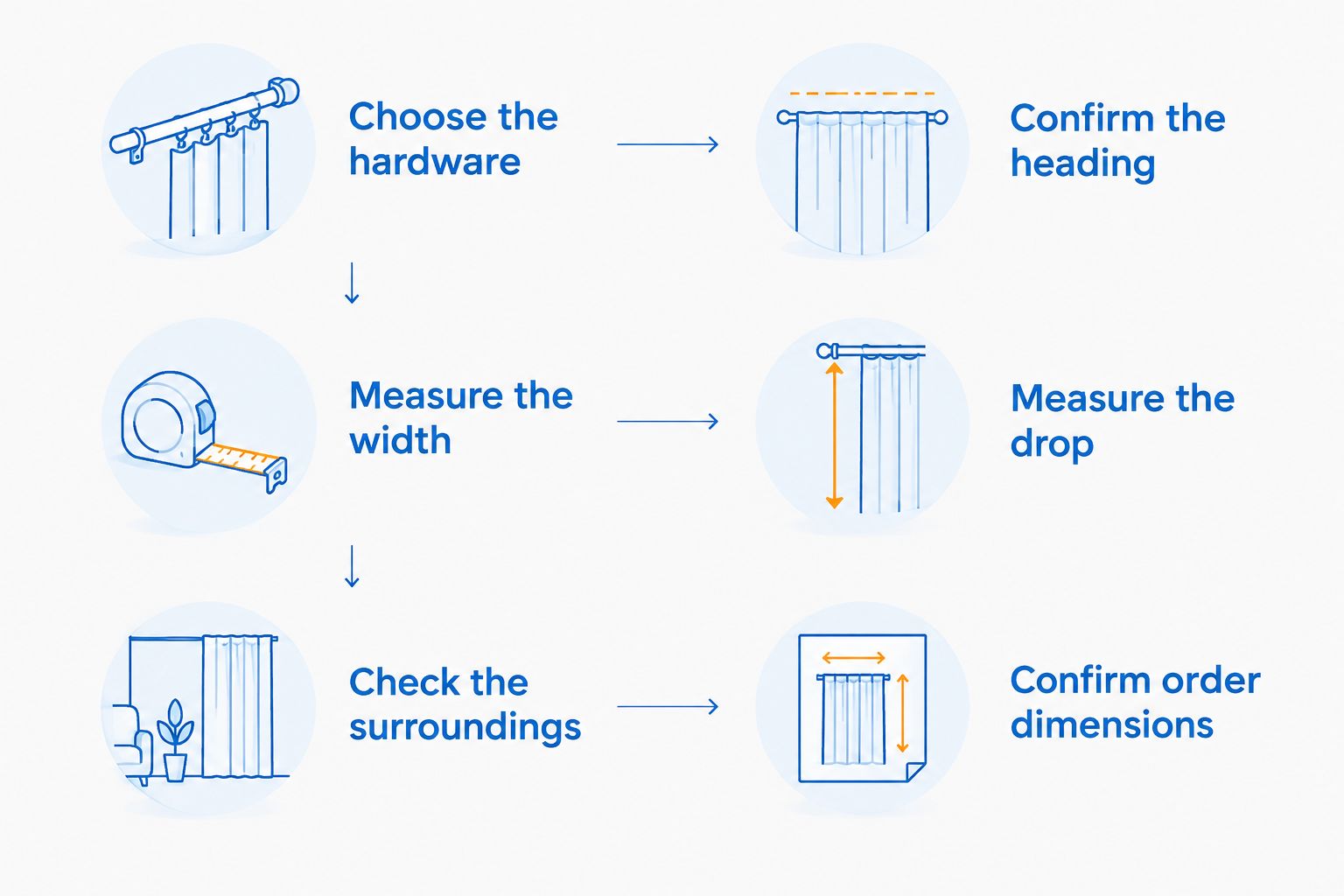
Use this sequence:
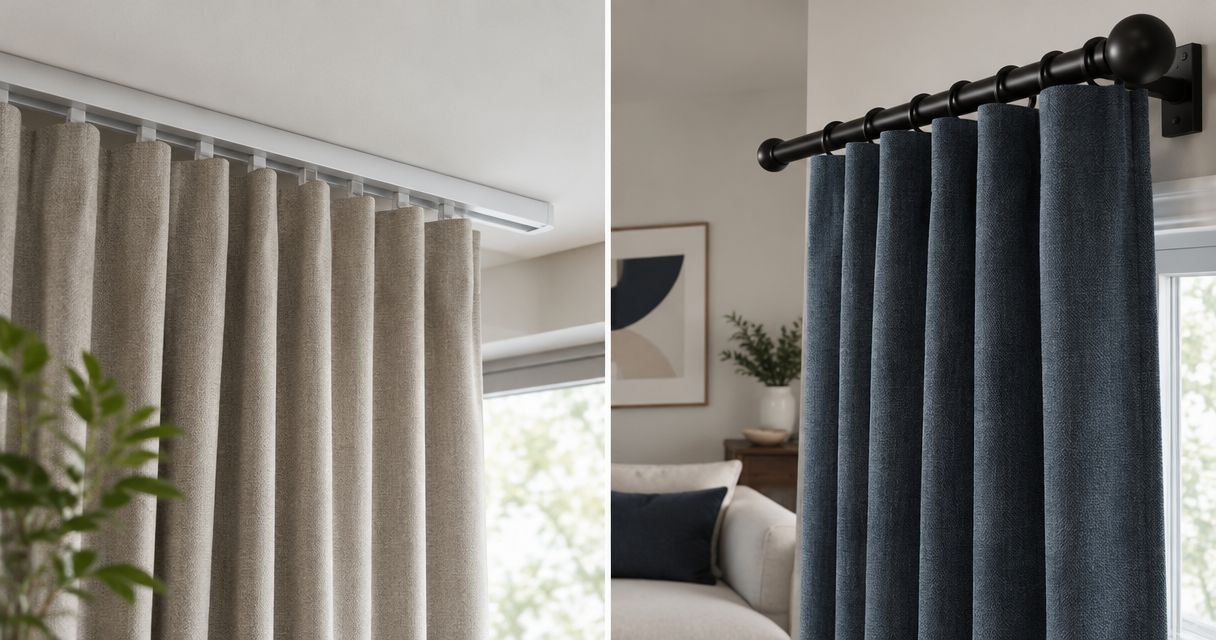
- Choose the hardware. Decide whether the curtains will hang from a rod or a track, and whether the fixing position is on the wall or ceiling.
- Confirm the heading. Ask where the supplier wants the drop measurement to start for your selected curtain heading.
- Measure the width. Record the usable rod length or track width, excluding decorative rod finials.
- Measure the drop. Measure vertically from the agreed starting point to your intended finishing point.
- Check the surroundings. Record handles, furniture, doors, ceiling features, and anything that affects opening or closing.
- Confirm the order dimensions. Ask whether the supplier needs hardware measurements, finished curtain dimensions, or another specified measurement.
Do not add extra width for folds or extra length for hems unless the supplier specifically asks you to. Those allowances belong to the curtain-making calculation, not automatically to your window measurement.
Why this matters
A curtain can have the right fabric and still fit poorly when the measurement starts from the wrong place. Window width describes the opening; curtain width must account for the hardware and the way the fabric hangs.
The same distinction applies to length. A measurement from the ceiling is not interchangeable with a measurement from a hook or curtain ring. Write the starting point beside the drop so the person making the curtains does not have to guess.
For privacy, consider the sides and centre as well as the fabric itself. Curtains need to cover the intended opening when closed, and their position must leave enough room for practical everyday use.
Before you measure: choose the final setup
Bring a tape measure, something to record your measurements, and a phone for photographs. Keep the tape straight rather than following a diagonal across the wall or window.
Use one unit throughout your notes. If you record centimetres, label every dimension in centimetres; if you record millimetres, use millimetres throughout. 1 cm equals 10 mm, so an unlabelled measurement creates an avoidable risk of misreading the order.
Before measuring, settle these details:
- Whether you want wall-mounted or ceiling-mounted hardware.
- Whether the curtains should finish near the sill or floor.
- Whether you want a single curtain layer or separate sheer and heavier layers.
- Whether the curtains should open from the centre or toward one side.
- Whether the existing rod or track will remain in place.
For a 2026 renovation, measure against the finished floor and confirmed ceiling arrangement. If flooring, ceiling work, or hardware placement is still changing, keep your early measurements as planning notes rather than final order dimensions.
If the rod or track is already installed
Measure the usable rod length between its end fittings, not across decorative finials. For a track, measure the track itself and flag any curves, returns, or unusual layout for the supplier.
Then identify the curtain's actual suspension point. Do not assume that the top of a rod, the bottom of a ring, and a track hook all produce the same finished drop.
If the rod or track is not installed
Mark the intended hardware position and record it separately from the window opening. Show where you want the curtains to sit above and beside the window, including the space needed for the fabric when open.
Treat these measurements as a proposed layout. Have the fixing position and curtain specification confirmed before approving production, especially where the ceiling or wall limits the installation choices.
How to measure curtain width
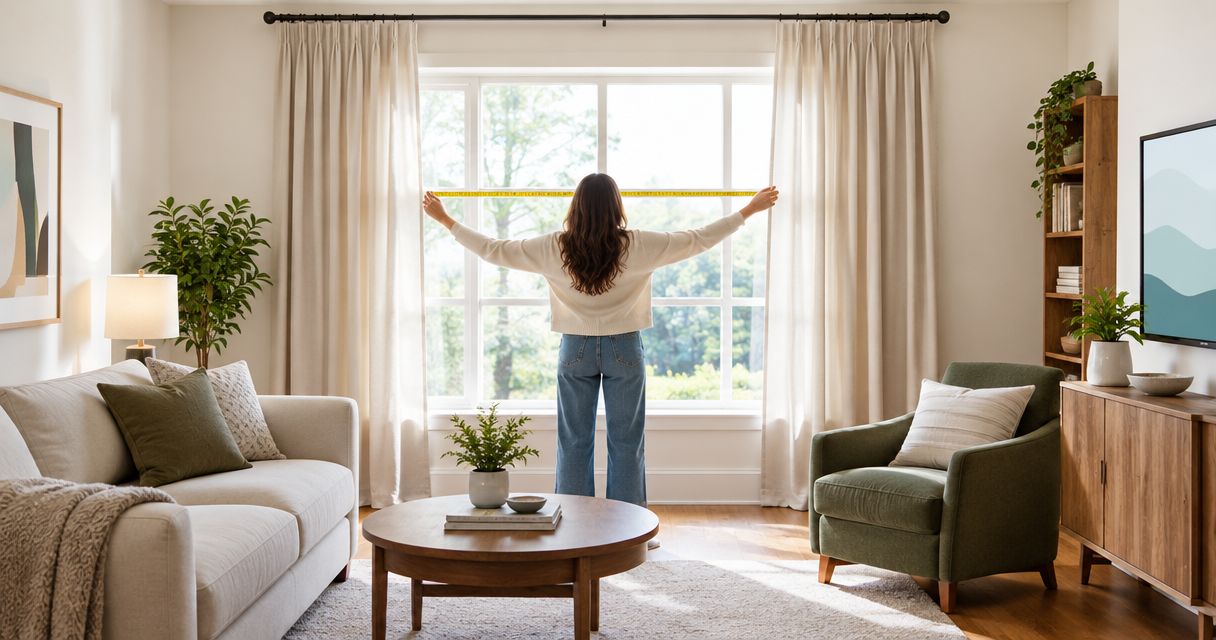
Start with the rod or track width that the closed curtains need to cover. If you only have the window-opening width, label it as that; do not rename it curtain width.
Next, consider where the fabric will gather when open. Curtains that gather over the glass reduce the uncovered part of the window. Curtains that gather beside it need suitable wall space and hardware placement.
Record nearby obstacles rather than assuming the hardware can extend equally on both sides. A corner, wardrobe, balcony door, or adjoining window can change the layout.
Keep coverage width separate from fabric width
The width that a curtain covers when closed is not necessarily its flat fabric width. Pleats and folds use fabric, and different headings create different amounts of fullness.
Do not multiply the track width by a universal fullness factor. Ask the supplier to calculate fabric requirements for the selected heading and material. Also confirm whether a quoted finished width describes a single panel, a pair, or the complete curtain arrangement.
Decide where the curtains will open
Centre-opening curtains and curtains that draw toward one side need different opening plans. Neither arrangement is automatically right for every room.
Choose the opening direction around how you use the space. Keep access to doors and handles in mind, and show the supplier where the curtains should gather rather than leaving that decision until installation.
How to measure curtain drop
Measure down from the starting point specified for the chosen heading. Hold the tape vertically and end at the intended fabric finish, not automatically at the window sill or floor.
For floor-length curtains, check the drop at 3 positions: left, centre, and right. This reveals differences across the opening that a single measurement misses. Record all readings instead of silently choosing one.
Do not average uneven readings without discussing the intended finish. A level curtain line and a consistently small floor clearance are different goals when the floor itself is not level.
Confirm the heading's starting point
Eyelet curtains pass over a rod, while hooked headings hang from their specified attachment points. Fabric can extend above those points, so the measurement convention matters.
Ask a direct question: should the drop run from the hardware attachment point or from the intended top edge of the finished curtain? Record the answer alongside your measurement.
Measure to the finished surface
Take floor-length measurements to the finished floor, not a temporary surface that will later change. Include rugs in the discussion if the curtain will hang over them or sweep across them when opening.
For your 2026 order, confirm whether the supplier expects the final curtain drop or a raw measurement to the floor. Do not subtract a clearance allowance unless that instruction is clear.
Which curtain length should you choose?
Choose the finishing point around daily use, not appearance alone. Each option changes what you measure and how the curtain behaves around the window.
| Finish | Suited to | Advantage | Trade-off | Measurement endpoint |
|---|---|---|---|---|
| Sill length | Windows with furniture or fittings below | Keeps fabric away from the floor | Does not create a floor-length look | The agreed finish near the sill |
| Floor length | Rooms where you want a full-height curtain line | Gives a continuous line toward the floor | Needs careful checks across the opening | The agreed finish above or at the floor |
| Pooled length | Decorative areas where extra fabric is intentional | Creates a relaxed fabric finish | Fabric rests on the floor and needs space | The agreed finish beyond floor level |
Choose the finish before approving the drop. Do not order floor-length curtains and decide later that you want fabric to pool; that changes the finished length.

For doors, busy family spaces, and business interiors, check that the chosen finish does not interfere with movement or opening. A decorative finish should still work when someone uses the window or walks past it.
Why custom curtain measurements vary
Custom curtain dimensions vary because the measurement describes a complete hanging arrangement, not simply a rectangle of glass. These factors change the required width, drop, or both:
- Hardware position: Wall and ceiling fixing points create different starting heights.
- Curtain heading: The suspension point and fabric above it affect the drop convention.
- Opening direction: Centre-opening and side-drawing layouts change where fabric gathers.
- Layer arrangement: Separate sheer and heavier curtains need their own hanging positions.
- Room obstacles: Handles, doors, furniture, and corners affect placement and clearance.
- Finishing point: Sill-length, floor-length, and pooled curtains end at different places.
A second curtain layer deserves its own measurement check. Do not assume both layers have identical drops simply because they cover the same window.
For a 2026 room update, explore the custom curtains guide for Riyadh alongside your measurement notes. Keep the style decision and the fitting decision connected, rather than choosing fabric first and discovering a hardware problem later.
What should I send with my measurements?
Create 1 labelled record per window. Give each opening a clear name, such as living room left or bedroom balcony, and use that same name on photographs and order notes.
Include the following:
- Window-opening dimensions, clearly labelled as opening dimensions.
- Rod or track width, or the proposed hardware position.
- Drop readings and the exact starting point.
- Intended heading and finishing point.
- Opening direction and curtain layers.
- Photographs showing the whole window and nearby obstacles.
A photograph explains the setting; it does not replace a measurement. Take a straight-on view and a side view where handles, recesses, or projecting fittings need explanation.
For an office, shop, or other business space, label each opening independently even when the windows look identical. Confirm access and practical use with the person responsible for the room before finalising the curtain arrangement.
Do I measure the window or the curtain track?
Measure the curtain track for the coverage width when the track is already installed. Record the window opening separately if the supplier needs it to check coverage or plan replacement hardware.
If no track exists, provide the opening dimensions and your proposed curtain layout. An opening measurement is a planning input, not automatically a finished curtain size.
Should I add extra width for pleats?
Do not add an assumed pleat allowance to the measurement you submit. Provide the requested coverage width and let the supplier calculate fullness for the agreed heading.
If you are asked for flat fabric width instead, make sure that instruction is explicit. Coverage width and fabric width should never share an unlabelled box on your notes.
Can I measure custom curtains myself?
Yes, you can take the initial measurements yourself when you can safely reach the measuring points. Use professional support when the layout is difficult, the hardware is undecided, or the final dimensions need checking before manufacture.
Avoid stretching from furniture or guessing a high fixing point. Call Curtain-Store to discuss custom curtains and installation, then confirm what measurement support your particular order needs; use WhatsApp secondarily to share labelled photos and notes after the arrangements are agreed.
FAQ
Where do I start measuring the length of custom curtains?
Start at the measuring point specified for your chosen curtain heading. Confirm whether the supplier wants the attachment-point measurement or the finished curtain length, because those are not always the same.
Should I include the decorative ends of my curtain rod in the width?
No, exclude decorative finials when measuring the usable rod width. If the rod has an unusual shape or fittings, send a photograph and ask which points to use.
How many places should I measure for floor-length curtains?
Measure the drop at 3 positions: left, centre, and right. Record all readings so differences in the floor or fixing line can be considered before the finished length is agreed.
Do sheer curtains and heavier curtains need separate measurements?
Yes, check each layer against its own hanging position. Separate tracks or attachment points can create different drops even when both layers cover the same opening.
Can I order curtains using only the window's width and height?
Window width and height are useful for planning, but they do not fully specify custom curtains. The hardware position, heading, coverage width, and finishing point also need to be agreed.
Should I round my curtain measurements?
Record the readings you actually take rather than casually rounding them. Follow the supplier's requested units and precision when preparing the final order.
Does Curtain-Store offer custom curtains and installation in Riyadh?
Curtain-Store offers custom curtains and installation services for homeowners and businesses in Riyadh. Call to confirm the measurement arrangements and requirements for your order before approving the dimensions.
One last thing
Check the window while it is open, not only while it is closed. A handle or inward-opening section can occupy space that looks clear in a straight-on photograph.
Before approving your 2026 curtain order, open the window or door fully and review the proposed fabric and hardware positions. That simple check keeps the measurement tied to how you actually use the room.